Thursday, June 19, 2014

Instagram-Inspired Project-Based Learning

If you've read my previous post about how we've been using Instagram in kindergarten, you'd know that we've been avid Instagrammers for the last couple of months. #mathphotoaday and #eduphotoaday have provided the basis for many terrific mini-lessons, and captioning photographs has provided authentic early writing practice. I've been amazed at how successfully my students have used Instagram and supporting apps such as Pic Collage, InstaCollage, and Color Splash.

Last week, we were viewing our Instagram pictures on our SMART Board, and the kids were commenting on how beautiful a lot of them were. One little boy put up his hand and said, "Mrs. Caldwell, our Instagram pictures are so beautiful. I think that we should print them out and sell them and make money for our new playground." And just like that, a new project was born! Why does this always happen at the end of the school year when we have a million and one other things to do? But their enthusiasm was contagious and I agreed that it was a fantastic idea! And when a 6 year-old shows entrepreneurial spirit like that, who am I to stand in his way?

All of our projects are guided by a to do list that is projected on the SMART Board, and our first job was to find out if the playground project still needed money. A quick FaceTime call to the president of Parent Advisory Council confirmed that the project was finished and additional funds were not required. The kids soon came up with two other options: supporting our universal breakfast snack program and/or our brand new child care centre that is set to open this fall.

Our next task was to find somewhere that printed Instagram photographs. I had used both Sticky9 and Prinstagram before, so we visited both websites and did some cost comparisons. In the end, we decided to go with Prinstagram. We decided to order magnets printed with our existing Instagram pictures. This led to some terrific digital citizenship/responsible use learning opportunities as we discussed what pictures we should use and sell. We also discussed our audience and what they would be interested in buying--sorting shapes (probably not), a beautiful blue sky (yes).

With our magnets ordered, we explored the rest of the site and discovered that they also made greeting cards in 4 x 4 and 4 x 6 sizes. The 4 x 4 cards were cheaper, but we wondered if they were too small to go in the mail. My mom is a postmaster and my students know her, so they asked if we could Skype her and ask (hey Mrs. Caldwell, your mom is a post officer. Can we call her and ask?). My mom confirmed the students' suspicions when she said that 4 x 4 were too small to be mailed as standard letter mail, but people could pay extra to have them mailed. My students made the decision to still order 4 x 4 cards as they thought they wouldn't always need to be mailed.
Our discussion of audience and what people would like to see on cards led to the students making the decision to take a lot of new Instagram pictures. They predicted that people from Oak Lake would be interested in pictures of our town and its landmarks. They also thought that everyone likes flowers, so we needed more pictures of flowers. We walked around Oak Lake and photographed whatever struck the students' fancy. I was absolutely amazed by some of the spectacular pictures they shot independently. They also edited and designed collages using a variety of apps, completely independently. Have a look at their work! As you can see, these images are perfect for greeting cards.

Once the greeting cards and magnets were created and ordered, some new tasks had to be accomplished to prepare for our sale. The students named the project #instaawesome and had decided to sell our cards and magnets at Awards Day and Kindergarten Graduation when a lot of people would be in the school. Setting prices for the cards and advertising were two big jobs!
 We always set up our to do lists in three columns: task, who will do it, then a check off when done column.
Deciding what organization our profits would support was an important decision. We talked about our two options (new child care centre and our school's universal breakfast snack progam), then I gave students a few minutes to discuss with their neighbour before voting. It turned out that a vote wasn't necessary, as one of my little boys raised his hand and stated, "I think our money should go to the day care. There's little kids in our town and they need to have somewhere good to go so they can learn stuff and be ready for kindergarten." Another little girl added, "And some of us have little brothers and sisters. They need to have a place to go when our moms and dads are at work." Everyone agreed with this logic and it was unanimous that all funds raised would go to the new child care centre on our school grounds. Talk about substantive decision making!
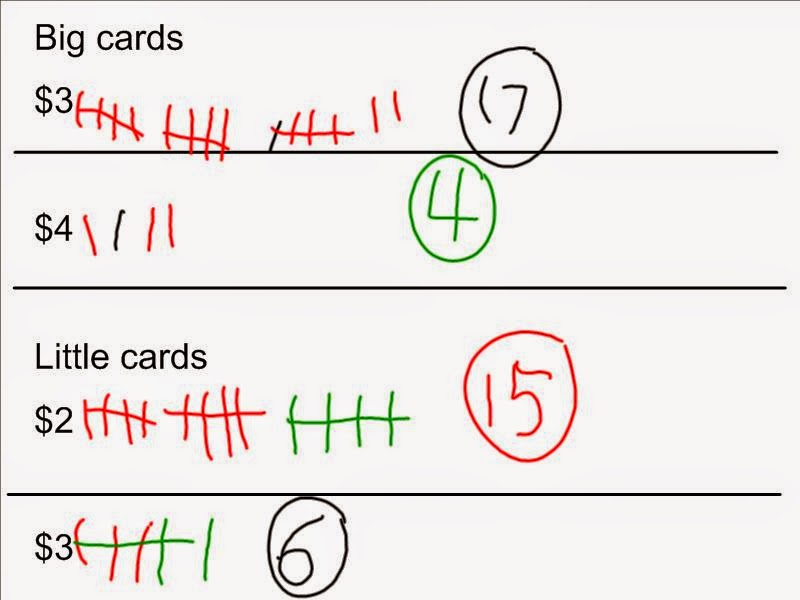
Setting prices was an activity rich in real-life learning. We needed to find out how much people would be willing to pay for little cards, big cards, and magnets.We decided to survey the adults in the school, so we took samples of our products and a clipboard to get the information we needed. Then we collated all our data on the SMART Board.

Because we wanted to ask more people than just the adults in the school, I suggested that we create a survey using Survey Monkey to give us more data for setting prices. We posted the link on my Facebook page and Twitter. After only an hour, we got 12 responses online which we included when we collated our data on the SMART Board. This information made it very clear to the students what prices we needed to charge for the cards.

This slide shows great problem-solving in action! It was a difficult concept for the students, but role-playing actually paying Prinstagram for each card helped them understand that we could not keep all the money for each card and what our actual profit would be. 

Next we used shared writing to compose a note to families in our school about our #instaawesome sale that would take place at Awards Day. The students strengthened their scissor skills by cutting the papers in half as there were two notes on each sheet of paper (great opportunity to teach the concept of half).Students decorated the notes, then surveyed each class to find out how many students there were. Printing the numbers on a clipboard to keep track, students were able to count out piles of notes for each classroom, and label them with a sticky note. It was very exciting delivering the notes!


Tomorrow is our card sale. The magnets haven't arrived yet, so we hope to sell those at Kindergarten Grad. Tomorrow morning, we will make a price list, a sign to advertise, set up our display, and practice using the coins to make change. It should be another exciting day of project-based learning in kindergarten!

Thursday, May 22, 2014

Coding in Kindergarten

For the last year, I've been hearing more and more about coding. At first I didn't even understand what people were talking about on Twitter...then I began to have flashbacks to my Grade 11 computer science class where we did computer programming in BASIC computer language! Hour of Code initiative, with a goal of more than 10 million students trying computer science for just one hour in school during Computer Science Education Week in December, caused me to do some research. But I still couldn't fathom how I would use coding in my kindergarten classroom.

My colleague Leah Obach and I had many discussions about coding, and how we could stretch ourselves to make it part of our early years program. We learned that the benefits can be numerous:
-develop critical thinking and problem-solving skills
-expose and engage all students to computer programming before stereotypes exist--it's too hard, computer science is for boys, "geeks/nerds", etc.
-kids aren't afraid and learn quickly at a young age

I still wasn't certain how to proceed until I read this Edutopia article,  15+ Ways of Teaching Every Student to Code (Even Without a Computer). It shared some tools for coding with young children that I was excited to try--Tynker and Kodable. Tynker is available online as well as an app (free and paid version). Kodable is available soley as an app, and it also has a free and paid version. So I installed both apps on my students' iPads and decided to give it a try yesterday. I didn't give a lot of introduction to my boys and girls, just explained that we were going to learn how to make animals, people, and objects do things on our devices. Instead of playing games, we were going to learn how to make things happen in games, and maybe someday make our own apps and games. 

I decided to try Tynker first, and the students were excited to dive right in. The main problem with Tynker for kindergarten students is that it gives the directions in text format, and doesn't read them aloud. My students are early readers and managed to read some of the basic words, and I read the rest to them. Tynker uses Lego-like pieces that fit together to form a chain of commands that operate the character on the screen (such as walk, jump, repeat, etc). Despite the problem with reading everything independently, my students were very excited to use the Tynker app and were completely engaged for for 25 minutes. I provided support and suggestions as needed, but I really encouraged my young learners to figure things out through trial and error. I also suggested that they could work together if they were really stumped. In our first coding session, I saw some great problem-solving, logical thinking, and basic numeracy/literacy skills in action!

Tomorrow, we will experiment with Kodable, an app that uses a sequence of arrows to move a character through a course. Stay tuned as we compare these two apps for coding with our youngest learners!

Monday, May 12, 2014

Exploring the Hundred Chart with Mystery Number Skype

We have used Skype extensively in kindergarten for a number of years, but we have never participated in Mystery Number Skype. After attending Kathy Cassidy's presentation at Awakening Possibilities last month, I was inspired to put this idea into practice with my colleague Leah Obach and her grade 1 class.

How does Mystery Number Skype work? Well it's beyond simple actually! Each class chooses a mystery number based on whatever criteria you have set. We are currently focusing on numbers 1-100 at the moment. The classes then connect on Skype. One class goes first, and asks the other class yes/no questions to narrow down what the mystery number could be. Once the first class guesses the number correctly, the other class takes their turn. McGraw-Hill's Monster Squeeze app is a great way for students to increase their understanding of how to narrow down a range of numbers.
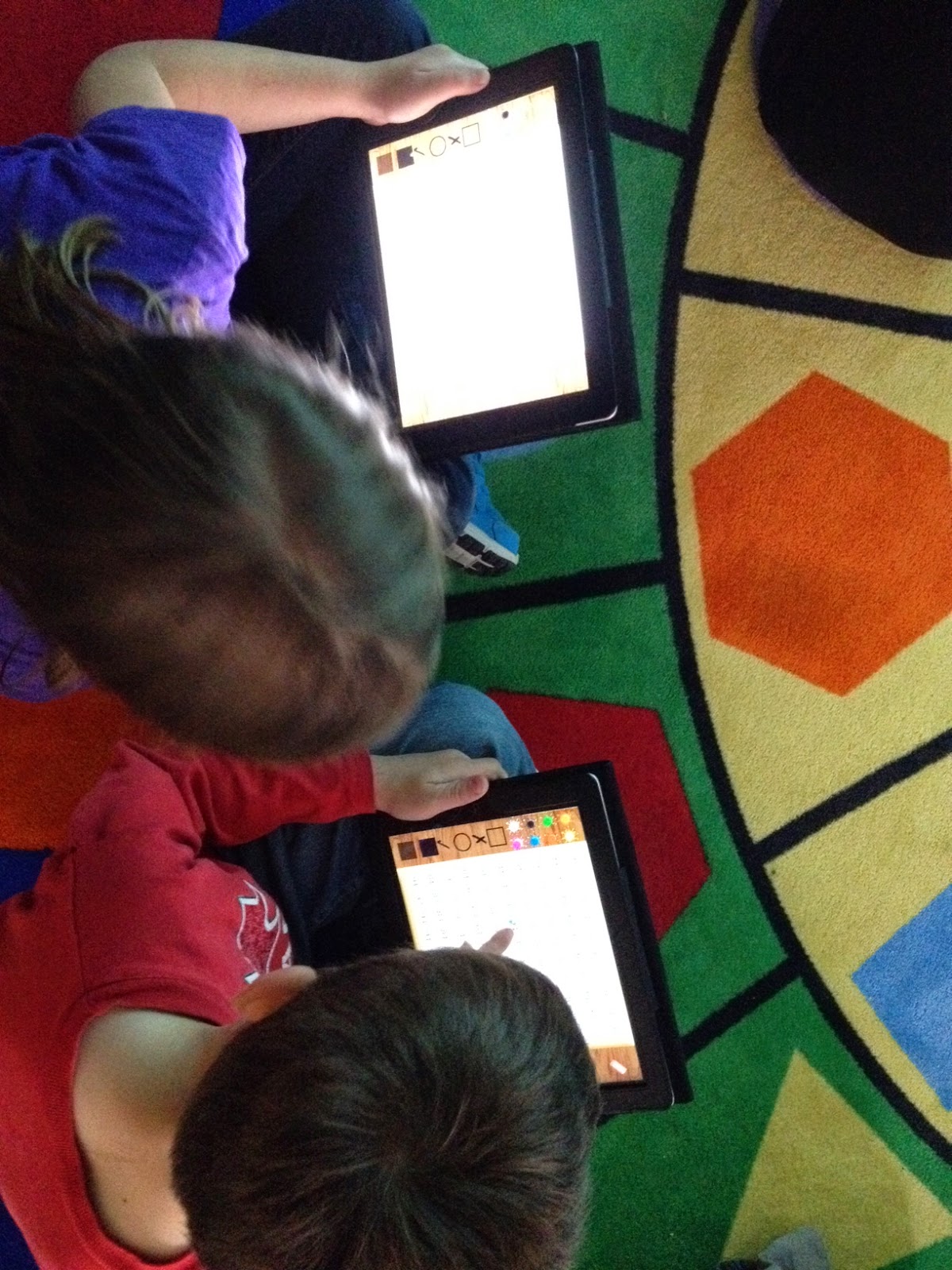
We share the screen and use the interactive hundred grid in SMART Notebook to give both classes a visual. As it is narrowed down, students flip over the numbers. My students each have their own device to use, so we are using the Hands On Math Hundred Chart app. Learn more about how the app works in this tutorial video. Students were super engaged as they asked questions and coloured in numbers on their device during Mystery Skype.

 We have done mini-lessons on "smart" questions to ask, and these are the questions we are hearing from our students during Mystery Number Skype:
Is it higher than __?
Is it lower than __?
Is it between __ and __?
Is it in the forties, fifties, sixties, etc.?
Does it end with a __?

After three days of Mystery Number Skype, Leah and I have decided that a few new mini-lessons are needed to stretch the students' thinking and question-asking abilities. Topics we plan to address in the next week include odd/even numbers, skip counting patterns, and the difference between "teen" and "ty" (decade) numbers. Leah's Grade 1 class already demonstrates a good understanding of teen/ty numbers, so her students may actually teach a mini-lesson to my students.

Today our classes competed to see who could solve the mystery number asking the fewest number of questions. We tallied each question on the SMART Board as they were asked, which definitely increased student motivation to ask "smart" questions. This provided another role for students to play during Mystery Number Skype as well as some great skip counting practice.

After only 3 days of Mystery Number Skype, I am really impressed by the growth I've seen in my senior kindergarten students' abilities to use and ask reasonable questions about the hundred chart. Their excitement and engagement is through the roof as well. If you're looking for a fun way to connect with another class and develop 21st century skills in your students while boosting numeracy skills, this is it!

Learning and Sharing in Spain and Canada

Repost from my contribution to Mindshare Learning Report, May 2014 edition:

In the past two months I’ve had access to some amazing professional learning. Here are some highlights from my travels around Canada and the world!

March started off with a bang when I flew to Barcelona, Spain, with my colleague and best friend Leah Obach, to attend Microsoft in Education Global Forum. This 4-day event brought together 1100 teachers, school leaders, and education leaders from 75 countries. Leah and I were there to share our collaborative project, Little Hands Extended. We attended fantastic keynote sessions, participated in a 24 hour Learn-a-thon where we developed innovative projects with teachers from all over the world, and celebrated at a gala evening. To learn more, view my video and check out the Microsoft Educator Network! 


 I was home for two weeks, then it was off to National Congress on Rural Education in Saskatoon, SK. My school principal, Brenda Masson, and I presented on our Smart Start Kindergarten program, and took in some terrific professional learning sessions. Highlights included: Jade Ballek and Terry Epp’s session on 21st century learning competencies clearly detailed how their school division is putting pedagogy first. They shared some terrific resources on 21st learning and innovation, connecting through Skype in the Classroom, and using infographics in education.

Kimberly Schonert Reichl’s keynote presentation on educating the heart and mind to develop emotional intelligence shared important connections to academic and interpersonal success. She encouraged teachers to access video resources from the Dalai Lama Centre for Peace and Education, teach mindfulness with the Mind Up! Program from the Hawn Foundation, and infuse social-emotional learning throughout curricula with resources from CASEL.

April brought a fantastic ed tech conference in my home province of Manitoba. Manitoba Teachers’ Society’s Awakening Possibilities gave Leah Obach and I the opportunity to share about project-based learning and the tech tools that support it, while taking in some inspiring sessions. Steve Dembo set the tone for the conference with his keynote message that encouraged teachers and schools to take pride in being first. Dembo stated that cutting edge, innovative teachers and schools are often regarded as crazy but we should wear that crazy label like a badge of honour—the rest will come around soon enough! Dembo also shared some fun and useful tech tools, such as 1 Second Everyday app.
Attending Kathy Cassidy’s session Connected from the Start: Global Learning in the Primary Grades was an excellent reminder of how ICT tools coupled with strong pedagogy create and support digital learners. Blogs, Twitter, and Skype are Kathy’s go-to tools, and digital citizenship is interwoven throughout learning experiences. Mystery Number Skype, blogging to create digital portfolios, movie-making, and shared reading of blog comments/tweets develop important numeracy and literacy skills in Kathy’s Grade 1 classroom. Kathy suggested Edublogs and Kidblog as two great tools for early years teachers interested in blogging with their students.

Other great takeaways from Awakening Possibilities:
* Nadia Nevieri explained how her school has revitalized morning announcements with engaging video announcements. Learn more here!
* Erin Clarke presented on the many uses of Instagram in early years classrooms 
* Raman Job shared iPhone photo tips and tools: Haiku Deck for presentations, Snapseed and Tangled FX for editing pics, Touch Blur to protect student privacy, and Quipio and Phonto for creating and sharing text over images (memes/quotations).

Chris Lehmann, founding principal of the Scientific Leadership Academy in Philadelphia, ended two incredible days of learning with a riveting closing keynote. His most important points that I felt compelled to tweet:
* Collaboration means doing things differently because we are doing them together.
* Technology should be like oxygen. Ubiquitous, invisible, and everywhere.
* A vision without a plan is nothing more than a hallucination.

And now comes the challenging part—sifting through all these wonderful ideas and tools and deciding how I will use them to affect change in my classroom and school community! Off to Riding the Wave of Change in Gimli, Manitoba, this week, so stay tuned as I tweet from that conference.

Monday, April 28, 2014

Instagram in Kindergarten!


Instagram MOM Session from emalkoske

Leah Obach and I had the privilege of sharing Little Hands Extended (project-based learning and the tech tools that support it) at Awakening Possibilities in Winnipeg earlier in the month. We gave our presentation at the Minds on Media session, which featured a number of concurrent presentations in a large room. Erin Clarke was presenting just across from us, and although I was never able to hear her entire presentation, I caught enough snatches of information to capture my interest. Fortunately Erin shared her presentation on her blog, 200 Awesome Days and I have embedded it above.

Instagram was a hot topic at Awakening Possibilities--many people were using it to capture the many amazing sessions at the conference, and many people were talking about how it can improve and support learning in their classrooms. I have used Instagram personally for about a year now, and I find that it fulfills a creative need for me as I edit and share images with friends. But how would I use it in kindergarten? I spent some time researching how Instagram could look in a kindergarten classroom and got some great ideas. I decided that using Instagram in my classroom could help me achieve the following outcomes:
-develop students' emerging writing skills as they caption and hashtag pictures
-create an authentic purpose for writing
-capture and share our learning with parents and other kindergarten classes
-provide an artistic medium for students to express themselves creatively
-to appreciate and share the beauty around them
-learn about other classrooms and geographic regions around the world
-develop an understanding of the world around us as we plot the classrooms we follow on a Bing map
-meet curricular outcomes by participating in challenges such as this one. Thanks Zoe Bettess!

 Last week I decided to dive in and use Instagram for the writing component of our guided reading lesson. First of all, I created a private class account, @olcskinders, for my little ones to use. I began by sharing my personal Instagram account with my senior kindergarten students, talking about the kind of pictures I shared, the captions I wrote, and the hashtags I chose. Then I showed them how to take a picture in Instagram, crop it, and use filters. They caught onto this instantly, so I handed out their devices and gave them the job of taking one photograph and returning to the circle. Together we wrote captions and chose hashtags, and the students were so excited with the results of their first Instagram efforts. Together we looked at everyone's pictures, and began to have some discussions about digital citizenship. Who could we take pictures of? Could we use people's names in the caption or hashtag? As I have signed permission forms from all families, here were the rules we came up with to get started:

1) Take interesting pictures that are neat to look at or show our learning.
2) We can only take pictures of the people in our classroom, not the rest of the school.
3) If we want to take a picture of a staff member, we need to ask them first.
4) All pictures need a caption. We cannot use the person's name in the caption or hashtag.
5) We can hashtag our Instagram pictures with our names so people know who took the picture.

I also decided that we would let our students' families follow us, but we would not follow them back (as all content they post may not be appropriate or interesting for kindergarten students).

 Our first Instagram pictures turned out great!
After using Instagram for one day last week, my student teacher and I decided that students needed a word wall to help them print frequently occurring words in captions and hashtags. Miss Anderson did a fantastic job of creating this one!
This morning, we decided to explore a couple of fun apps that Erin Clarke recommended in her Instagram presentation. I was super impressed how quickly my little ones caught on to using Color Splash and making collages! Wow!
https://itunes.apple.com/ca/app/color-splash/id304871603?mt=8

https://itunes.apple.com/us/app/instacollage-pro-pic-frame/id530957474?mt=8
My students are already reasonably proficient Instagram users, so what are our next steps?
-continue to develop our ability to write captions and hashtags
-improve our ability to post quality, interesting images
-develop our ability to read and respond to comments on our pictures
-explore apps to enhance our use of Instagram
-implement a rule similar to Erin Clarke's--for every image you post, you must comment on someone else's image

Take a look at some of our first Instagrams!


Saturday, April 26, 2014

Discovering Discovery Bins

In the past two years, through my involvement with Manitoba Education's Early Childhood Unit, I have been incredibly fortunate to meet a lot of wonderful kindergarten teachers. I have learned something from all of them, but Connie Lowe is a new friend who has had a real impact on my classroom practice. Learn more about what happens in her kindergarten classroom by reading her blog, Adventures in Kindergarten. I'd heard her talk about the discovery bins she uses in her kindergarten classroom, and one night over supper I quizzed her about them. She explained the concept and directed me to her Pinterest page which was full of great ideas. I returned home, excited to try discovery bins in my classroom the following week!

Discovery bins, as their name suggests, encourage discovery, exploration, and investigation. They feature a variety of materials, and the teacher may include an example of how the materials might be used. Discovery bins can promote fine motor development, creative expression, and literacy/numeracy skills. The activities are open-ended, and there is no right or wrong way to interact with the materials. We spend the first 30 minutes (more or less, depending on student engagement) of the day exploring our discovery bins. It is such a pleasant way to start the day--the students are so eager to work with the materials that they rush to do their morning jobs and head straight for the tables!

Here are some of our discovery bins so far...
First day of pattern discovery bins included a variety of materials as well as examples of patterns. Later in the week, I provided strips of paper and students were encouraged to describe their patterns using letters, numbers, symbols, etc. The old keys I included were absolutely fascinating to the students. They loved examining them and had a lot of questions about where they came from. When I told them they were found in the drawer of a captain's desk from an old naval ship in Scotland, they were even more interested!
 Paint samples, foam board, paper trimmers, and glue were provided for students, and led to many engaging sessions as they created their own mosaics.
 Egg carton ten frames, cubes, and paper to print number sentences showed me how capable my students were of creating and representing equations. I was shocked! Later in the week, I added dice and spinners to generate numbers for equations.
 
Sometimes discovery bins can be just TOO exciting and engaging...exploring buoyancy led to altercations over boats and marbles, and the students were overexcited for the rest of the morning. Lesson learned!
Exploring magnetism was a great topic for discovery bins. Later in the week, I added small plastic bottles and containers with iron filings inside. Some students decided to sort the materials based on whether or not they were magnetic.
Geoboards, elastics, and pictures of shapes were a fine motor activity as well as an opportunity to explore shapes. Later in the week, I added dot paper so students could draw pictures of the shapes they created. These discovery bins were a good example of how students access discovery bins at every level--some students were completely engrossed stretching elastics around the pegs and never created any shapes. It was great fine motor development at the very least!

So what do I do while my students are engaged with discovery bins?
  • I circulate around the room and observe.
  • I ask questions to encourage students to investigate further, become more involved with the materials, and hopefully challenge them to take their learning to the next level.
  • I make assessment notes in students' Evernote folders
  • I take photographs of what students have created and post them to our classroom Facebook page, Twitter account, and Instagram
  • I encourage students to use their iPads to photograph their work. We are just learning how to make photo collages on our iPads and use Instagram, so that is an exciting new way to share what we are doing with discovery bins.
I encourage all kindergarten teachers to expand their classroom practice with this student-led and highly engaging approach--my students and I look forward to discovery bins every morning, and they have been a great addition to our kindergarten program!

A year later--read my student teacher's post on how discovery learning has evolved in our kindergarten program!

Wednesday, March 19, 2014

Supporting Numeracy Development Through Project-Based Learning

Throughout the school year, my junior and senior kindergarten students engage in a variety of project-based learning activities. What are my goals for project-based learning at such a young age?
-students will cooperate and collaborate with others to identify real-world issues that are important to them
-students will develop and implement action plans that address these important issues/topics
-students will use ICT responsibly to build knowledge, achieve curricular outcomes, and think critically/creatively in authentic situations
-students will become informed, responsible decision-makers, playing active roles as global citizens' who contribute to the well-being of others

Watch an overview of our project-based learning with our partner classroom, Mrs. Obach's Grade 1 students!

In the past few years, project-based learning has become very engaging and interdisciplinary in my junior and senior kindergarten program. As the teacher, it is my job to identify relevant teaching and learning experiences and skills that are crucial to the students' abilities to implement their plan. Often, mathematics skills are strongly developed within the context of project-based learning. Take a look at the skills developed and curricular outcomes achieved as we've explored some very real issues in our projects! Many times, students don't realize that they are "doing math". Instead they are acquiring and using skills that are paramount to the success of their real-world project. This is learning for a purpose at its finest!

Hopping to Help: when a student brought a frog for show and tell, everyone became very interested in researching frogs. When the students learned that the Oregon spotted frog was an endangered species, they held an iced tea and lemonade sale to raise money to help with preservation efforts.

What important mathematical learning occurred during this project?

1. Students conducted surveys to determine which drink was most popular. They surveyed students in the school using clipboards and tally marks. They reached a larger audience using Survey Monkey and social media. 

 Once students collated the data, they learned that iced tea was the most popular drink. The next job was to estimate how many glasses of iced tea were in each jug. Students made a graph on the SMART Board to share their predictions.
 Students measured and counted to make many batches of homemade iced tea.
 Students experimented with jugs of water and glasses to increase their understanding of capacity.
Students experimented with fractions and practiced reading numerals as they mixed and baked cookies for the sale.
Students themselves identified that they would need to learn how to use money for the iced tea and cookie sale. We decided that what was most important was that they learn to recognize the coins and bills and how much they were worth, and adults would help them make change. We used our interactive response system to practice money skills and played with coins at our practice iced tea and lemonade centre.
 Students counted how many students were in each classroom, recording on a clipboard. They counted and labelled notes (printing the grade and number of students) to distribute to each classroom advertising the sale.
 Students held two sales: one outside the Co-op store and one at school. Students counted cookies, glasses, and jugs of lemonade. They estimated how many cookies would fit on a plate and counted to check.
 When the sale was over, we worked together to count coins and bills, exploring how skip counting could make the task easier.
Throughout the project, a great deal of real-life problem-solving took place, allowing different students to shine--not just those with strong academic skills. Through play and project-based learning, a variety of rich mathematical learning can take place!