Showing posts with label math. Show all posts

Monday, November 19, 2018

Count on Project-Based Learning: Strengthening Students' Numeracy Skills Through PBL

Project-based learning.  You've probably heard about it...but is project-based learning an appropriate pedagogical approach for developing numeracy skills in young learners? That is the topic I tackled last month when I spent the morning presenting at Manitoba Association of Math Teachers' MTS PD Day Conference, Rolling the Dice on Change.  For more than ten years, project-based learning has been my favourite tool for investigating student-initiated, real-world topics with young learners.  I was excited to dive deeper into the existing research and unpack how this pedagogical approach can strengthen numeracy skills in young children.

First of all...what is project-based learning? This video has been around for quite a few years, but it was developed by the Buck Institute for Education (an excellent resource for K-12 teachers implementing project-based learning) and does a nice job of explaining the approach.  In my own experience, I have found project-based learning to be a cyclical approach that uses student interests and real-world issues and problems as the curriculum of the classroom.  Usually, project-based learning is interdisciplinary and facilitated (rather than led) by the teacher, who teaches relevant mini-lessons and weaves in curricular outcomes to move the learning projects forward.  Sometimes, project-based learning is collaborative as partnerships are formed with other classrooms and organizations.  A few examples from my classroom practice are detailed here:
Walking for Polar Bears
MakerFaire and Yoga Festival 
Love Family Adoption Party 
Reindeer Rescue
Baby Love Baby Shower
National Sweater Day
Connected Wellness Global Yoga Challenge 

What does the research say?
-project-based learning has been defined as an active, child-centred teaching and learning approach that uses student interests as the impetus for building knowledge and implementing authentic learning in real world settings (Kokotsaki, Menzies, & Wiggins, 2016).
-a project-based curriculum “promotes children's intellectual development by engaging their minds in observation and investigation of selected aspects of their experience and environment” (Katz & Chard, 2000, p. 2).  
-project-based learning is not an extra activity in the classroom; instead it is the curriculum itself, integrating provincial outcomes and fostering literacy and numeracy (Bell, 2010). 
-children build subject area knowledge and collaborative skills while displaying motivation and positive peer relations (Kaldi, Filippatou, and Govaris, 2011).  
-educators should challenge young children to solve real-world problems to spark creativity and innovation (Pramling Samuelsson, 2011). 

What numeracy skills may be developed through project-based learning?
Researchers have highlighted the importance of young children becoming proficient in subitizing (ability to recognize small exact quantities), comparison of the sizes of numbers, estimation, where numbers fit on a number line, and procedural and conceptual counting (Martin, Cirino, Sharp, & Barnes, 2014; Whyte & Bull, 2008).  The specific numeracy skills that arise out of project-based learning may vary depending on the learning project.  However, I have found that the numeracy skills identified by researchers occur in nearly every project-based learning opportunity in my early years classroom.  Depending on the project and the learning needs of my students, I may choose to focus more strongly on certain numeracy skills.  For example, if my Kindergarten students are struggling with teen numbers, I may spend a few days teaching mini-lessons and really examining and using teen numbers within the context of the project topic.  Here are some examples from project-based learning experiences undertaken in my classroom and in collaboration with my teaching partner and friend Leah Obach.

Counting
In every learning project, counting happens on a daily basis.  We count objects, people, votes/survey results, money, and materials.  We have many opportunities to match one-to-one as we count and compare quantities.  We count by ones, forwards and backwards, and sometimes we need to skip count.  What I believe is most important is that we are counting for a real purpose and the success of our project is linked to our ability to count accurately and quickly. 
Counting loonies and toonies from our Timbits sale and polar bear white ribbon campaign provided an excellent opportunity to strengthen our ability to count by ones and twos.  I encouraged students to set the price at $2 to facilitate these counting experiences.

Visuals on the interactive whiteboard and base ten blocks can help young children count larger quantities of money. 
Number Operations and Problem-Solving
There are many opportunities to use addition, subtraction, multiplication, and division to solve problems key to the success of the learning project.  When working with larger numbers, tools such as hundred charts, Power of Ten cards, and base ten blocks are invaluable supports in solving these problems. 
Students used large ten frames to investigate teen numbers and adding ten as they counted cups for hot chocolate for our National Sweater Day project.

Printing Numerals
Throughout our learning projects, we are frequently required to print numerals for a variety of tasks.  A sense of urgency is created as students are faced with recording numerals to keep track of results, recording and sharing new facts they have discovered, and creating and labelling materials.  Suddenly it matters that they can print numbers quickly and correctly. 
This student printed numbers to record how many students were in each class as his class prepared to hand out flyers advertsing a Timbits and white ribbon sale to support polar bears.  Students printed more numbers as they labelled the notes for each classroom. 
Students reviewed their guest list for their MakerFaire and yoga festival, using tally marks to determine how many invitations would be delivered by mail, division mail, by hand, and email. 

Working with Data and Making Data-Informed Decisions
When students are deciding how they will tackle an issue or how they will work to make a difference, differing opinions are often raised in the classroom.  Votes and surveys are essential for making fair decisions that reflect what the majority of students would like to do.  Additionally, we have polled our school and local community to determine the most popular cookies and beverages when planning events and sales.  Students have been excited to personally survey people in our school and to work with me to create online surveys using Microsoft Forms or Survey Monkey.  The results from our surveys have allowed us to move forward in our projects and base our decisions on real data, not just on our opinions and personal preferences. 
We used Survey Monkey to find out how much people would be willing to pay for greeting cards that we created with our Instagram photographs.  This project arose out of the students' interest in creating, editing, and captioning beautiful images for Instagram and a desire to support the new early learning centre that some of them and their siblings attended. 

Estimation
Sometimes using an estimation jar gets old and lacks authenticity.  Through learning experiences such as these ones, we have opportunities to develop important estimation skills to move forward with our projects. 
After experimenting with the capacity of glasses and jugs, we estimated how many glasses we would get from one batch of homemade iced tea.
We estimated how many cookies would fit on a plate for our bake sale.  We sold homemade iced tea and cookies to raise money for sick kids and the endangered Oregon spotted frog. 

Measurement
Depending on what the project calls for, we usually have opportunities to measure objects and physical spaces.  In keeping with curricular outcomes, we usually rely on non-standard measurement.  Occasionally, it is necessary to use standard units when comparing distances and mass. 
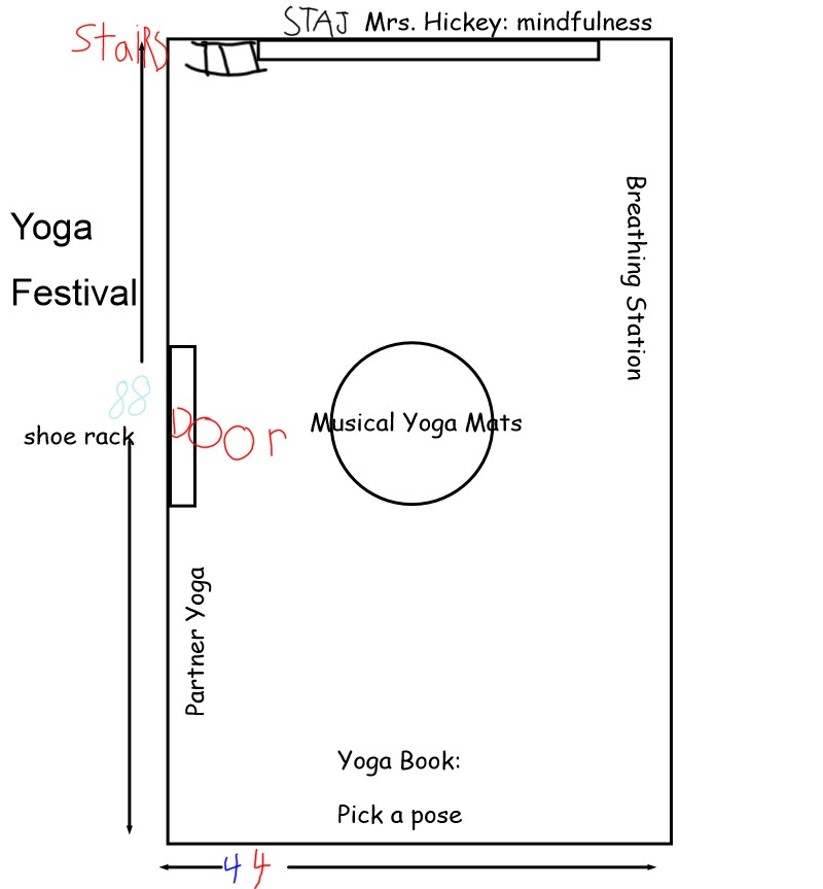
We planned and hosted a yoga festival for Internatonal Day of Yoga.  It was important to plan how we would design the physical layout of the space in the gym.  We used steps to measure the length and width of the gym, then created a sort-of-to-scale map on the SMART Board.

We decided to hold a Timbits and white ribbon sale to raise awareness and funds for how climate change affects polar bears.  We made the perfect white ribbon pin, then measured it with cubes.  We used cubes to measure 100 lengths of ribbon--lots of great lessons about measuring accurately!

Final Thoughts
Implementing project-based learning in your early years classroom will provide many opportunities for developing numeracy skills in authentic, real-world contexts.  This pedagogical approach creates an urgency for counting, comparing quantities, representing numbers, solving problems, estimating, and measuring--students begin to understand why these skills are important and how they are used in the real world.  

Keep your eye on the curriculum.  It is crucial that the teacher has a strong understanding of the provincial curriculum and acts as a facilitator to connect the students' interests with learning outcomes.  Based on observation and the demands of the project, the teacher must provide timely mini-lessons to support students as they build knowledge and develop and apply solutions.  It's all about the teachable moment...be prepared to go where students lead you and don't worry if the skill they need to develop (or at least develop familiarity with) isn't in the curriculum until Grades 3 or 4.  Exposure won't hurt your students, and some will get a lot out of it.  Additionally, it is important for the teacher to be mindful of what outcomes have been addressed through project-based learning and what outcomes need to be developed in future learning experiences. 

Don't try to fit a square peg in a round hole.  Not all project-based learning experiences will teach all numeracy outcomes, so don't try to force it.  Embrace what works naturally with the project, spend more time on the skills that need to be strengthened in your students, and develop other skills in future projects or lessons. 

Document and share learning.  During project-based learning, I constantly capture our learning through photographs, videos, and voice notes that are organized in Microsoft OneNote in a section for each child.  This evidence allows me to determine if students are meeting learning outcomes and provides valuable information for reporting.  For content that I'd like to share with parents, I upload images, videos, and work samples to Seesaw and our classroom Facebook page.  Sharing student learning with families allows them to see how their children are developing important numeracy skills through project-based learning. 

And remember...project-based learning isn't "dessert".  Don't wait until the end of the year when the curriculum has been "covered" to implement project-based learning.  This pedagogical approach isn't an add-on, an extra, or a reward for completing traditional learning activities.  Instead it is an important vehicle for capitalizing on student interests, engaging students in hands-on, real world learning, and developing important numeracy skills.  

Presentation slides and references available here.

Tuesday, May 17, 2016

The Daily Calving Report in Kindergarten

You just might be from a farming community when calving is a big deal in your classroom. For my big city colleagues, calving happens in late winter-early spring on Canadian beef farms when mama cows give birth to baby calves. When a farmer's cows are calving, it requires frequent checks at all hours of the day and night, and sometimes farmers have to help the cow give birth. Once the calf is born, it has to be tagged and documented. Many issues can arise during calving--emergency c-sections, mothers and babies that die, calves that won't drink, and mothers who reject their babies. In farming families, calving and the resulting successes and challenges are a frequent topic of conversation and there is no doubt that my little people are impacted by this. Some of my young learners check cows with their parents and bottle-feed calves. These little farmers can tell you the tag numbers of their favourite animals and use terms such as heifer, steer, cow, calf, and bull correctly. So after a number of days of children spontaneously reporting on calving on their farms, I decided to turn it into a learning experience. Giving my students' the support to pursue their interests while connecting it to curricular outcomes is hugely important to me, and it seems that these learning experiences can never be planned in advance--they just happen.

We began by including a hundred chart in our SMART Board calendar. Every student created a coloured, semi-transparent square to place on the chart to mark the number of calves on their farm. If students didn't have cattle of their own, they were related to someone who did--students reported on their grandparents' cattle for example.

After we recorded our calving numbers on the chart, we made comparisons among the numbers. I made a point of explaining that it wasn't a contest to see who had the most calves, but a way for us to learn more about numbers and share what was happening on our farms. However, that didn't stop my students from taking great joy in having more calves than Mrs. Caldwell most days!

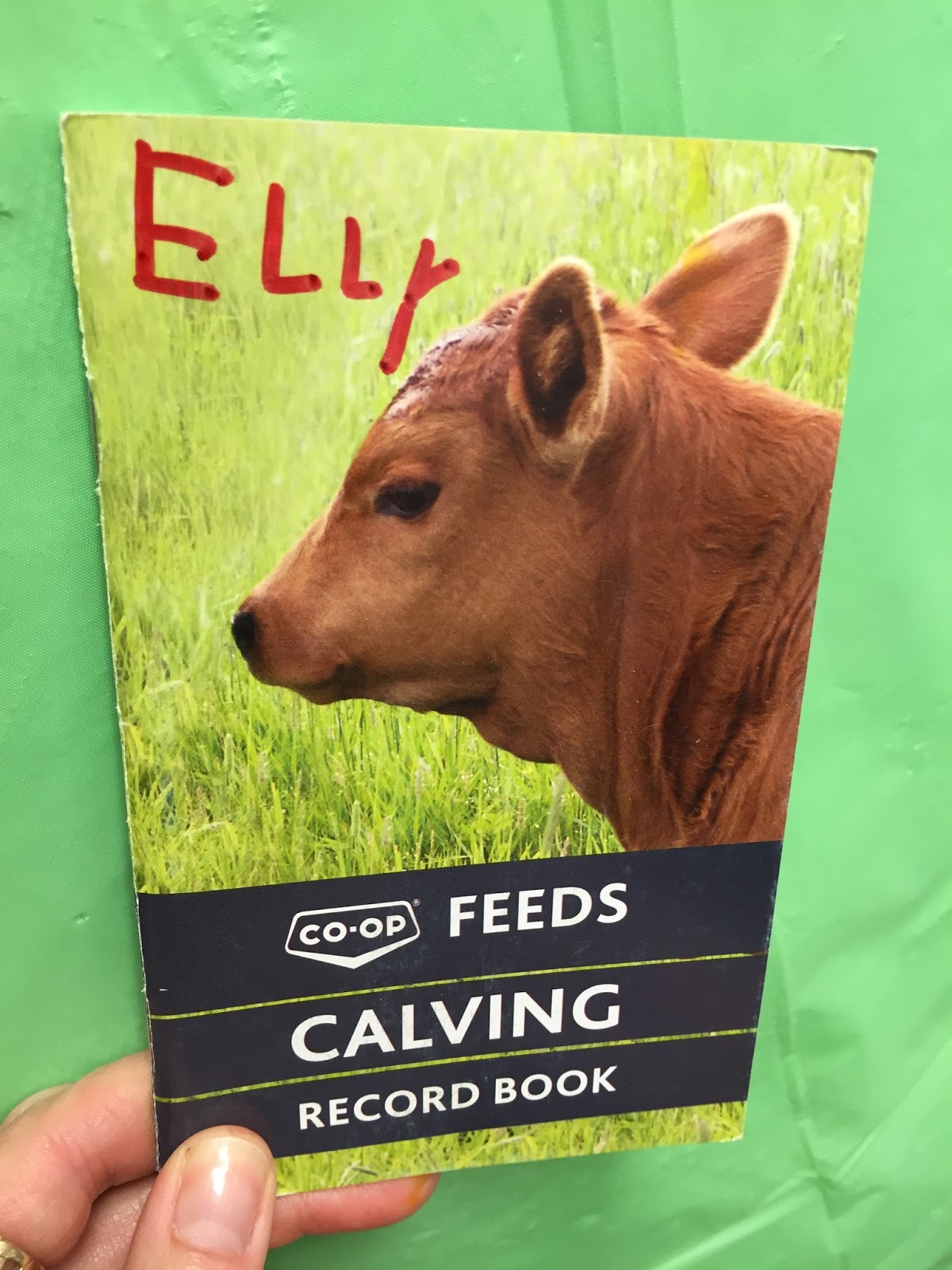
My local co-op feed and hardware store was kind enough to give each of my students their very own calving record book (the kind that real farmers use). So each day, we recorded our calving totals in our record books. This gave the students an opportunity to practice printing numbers as well as copying the date off the SMART Board (strengthening visual-motor coordination in preparation for Grade 1). 
Next we represented our numbers to share with our school population and through social media. We tried to represent our calving totals in different ways. 
 Using bingo dabbers to stamp our number on a hundred chart
 Use hand prints in fives and tens then printing the number
 Colouring our total on a hundred chart
Representing our numbers using ten frames
We displayed our daily calving report in the hallway outside our classroom. Lots of people looked at it and asked us questions about it. My students were eager to explain what was happening with calving, confidently using numbers from 1-300! 

Lastly, our daily calving report provided an opportunity for real-life problem-solving. This allowed us to explore early multiplication and skip counting. 

This learning activity was a huge success for a number of reasons:
-it emerged directly from my students' interests and students were highly motivated and engaged
-it fostered strong connections with families and extended families
-it underscored the importance of agriculture and helped kids take pride in their agricultural operations
-it provided an extremely relevant way for students to explore, represent, and compare numerals and quantities from 1-300 

Agriculture is an extremely important industry in rural Manitoba, and I'm proud to say that as young as kindergarten, we are contributing to the next generation of farmers!

"That's the thing about farming...you clock in at age 5 and never truly clock out." -Unknown

Wednesday, March 19, 2014

Supporting Numeracy Development Through Project-Based Learning

Throughout the school year, my junior and senior kindergarten students engage in a variety of project-based learning activities. What are my goals for project-based learning at such a young age?
-students will cooperate and collaborate with others to identify real-world issues that are important to them
-students will develop and implement action plans that address these important issues/topics
-students will use ICT responsibly to build knowledge, achieve curricular outcomes, and think critically/creatively in authentic situations
-students will become informed, responsible decision-makers, playing active roles as global citizens' who contribute to the well-being of others

Watch an overview of our project-based learning with our partner classroom, Mrs. Obach's Grade 1 students!

In the past few years, project-based learning has become very engaging and interdisciplinary in my junior and senior kindergarten program. As the teacher, it is my job to identify relevant teaching and learning experiences and skills that are crucial to the students' abilities to implement their plan. Often, mathematics skills are strongly developed within the context of project-based learning. Take a look at the skills developed and curricular outcomes achieved as we've explored some very real issues in our projects! Many times, students don't realize that they are "doing math". Instead they are acquiring and using skills that are paramount to the success of their real-world project. This is learning for a purpose at its finest!

Hopping to Help: when a student brought a frog for show and tell, everyone became very interested in researching frogs. When the students learned that the Oregon spotted frog was an endangered species, they held an iced tea and lemonade sale to raise money to help with preservation efforts.

What important mathematical learning occurred during this project?

1. Students conducted surveys to determine which drink was most popular. They surveyed students in the school using clipboards and tally marks. They reached a larger audience using Survey Monkey and social media. 

 Once students collated the data, they learned that iced tea was the most popular drink. The next job was to estimate how many glasses of iced tea were in each jug. Students made a graph on the SMART Board to share their predictions.
 Students measured and counted to make many batches of homemade iced tea.
 Students experimented with jugs of water and glasses to increase their understanding of capacity.
Students experimented with fractions and practiced reading numerals as they mixed and baked cookies for the sale.
Students themselves identified that they would need to learn how to use money for the iced tea and cookie sale. We decided that what was most important was that they learn to recognize the coins and bills and how much they were worth, and adults would help them make change. We used our interactive response system to practice money skills and played with coins at our practice iced tea and lemonade centre.
 Students counted how many students were in each classroom, recording on a clipboard. They counted and labelled notes (printing the grade and number of students) to distribute to each classroom advertising the sale.
 Students held two sales: one outside the Co-op store and one at school. Students counted cookies, glasses, and jugs of lemonade. They estimated how many cookies would fit on a plate and counted to check.
 When the sale was over, we worked together to count coins and bills, exploring how skip counting could make the task easier.
Throughout the project, a great deal of real-life problem-solving took place, allowing different students to shine--not just those with strong academic skills. Through play and project-based learning, a variety of rich mathematical learning can take place!


Thursday, September 27, 2012

On a Roll with Dice Games!

I had a fabulous day with my kindergarten PLC (professional learning community) on Monday. Our topic was math games for developing early numeracy skills. One teacher in our group did a wonderful job of collecting and sharing a wealth of dice games. I was eager to return to my classroom and try them out, and my students absolutely loved the first two games! I have created SMART Notebook files for the games as well as actual game boards.

Tug of War
To create paper game boards: cut a long strip of heavy construction paper. Place a large sticker in the middle, and equally spaced smaller stickers on each side (as many as you like depending on students/skills being practiced, but use at least 5 on each side). Students play in pairs, with each student sitting at one end of the game board. Depending on the age of the students/skills you are working on, you can use 6, 8, or 10 sided dice or spinners. An object is placed in the middle of the game board on the larger sticker. The first player rolls/spins, and moves the object that many spaces towards him/her. The second player rolls/spins, and moves the object that many spaces back towards him or her. Play continues until one player has the object right in front of him/her on the closest sticker. My rule is that to win, students must roll the exact number of spaces they need.

In my classroom, we first watched a YouTube video showing a tug of war, as my five year-olds weren't certain about what a tug of war looked like. Next, we played this game on the SMART Board (see files below), with the teacher and special helper playing against the rest of the class. I have included two versions of the game board. More spaces could be added on each side, and a 10 sided-die could be used from the gallery in SMART Notebook.

Once students were confident playing the game, we played in partners using our paper game boards. Lastly, we skyped our partner class and taught them the game. We challenged them to a tug of war, using SMART Bridgit for interactive play.

Tug of War SMART Notebook File

Tug of War Game Board 2 SMART Notebook File

Race to Trace
This game focuses on rolling a die and identifying the dot pattern or number, then correctly tracing that number. The first player to have all of his/her numbers traced wins. If the student rolls a number that has already been traced, I decided that he/she would choose a different colour and re-trace the number (creating a "rainbow" number, for additional practice). The happy faces indicate where the student should start printing the number. I have cloned this game board, and if you select dual page view in SMART Notebook, you will have two game boards side by side. The special helper and I played against the rest of the kindergarten class. Then, I printed out copies of the game boards and the students played against each other. This was another popular game, and a great way to practice correct number formation as well as identifying dot patterns on a die.

My plan is to introduce two new games per day until we have 6 games that we can play. These games will then become math centres, enabling me to work with small groups of students while the rest are engaged and having fun with these dice games.
Race to Trace SMART Notebook File

Tuesday, May 1, 2012

3-D Objects: Lesson Ideas

Shapes are often a fun break from the more serious business of learning about numbers in kindergarten math! For the next week, we are focusing on 2-D shapes and 3-D objects. My student teacher led our first 3-D objects learning experience today, and I thought that I would devote this blog post to sharing some of our favourite resources.

Created in SMART Notebook, this activating activity uses the screen shade to cover drawings of 3-D objects. We reveal the object slowly, taking guesses as more is revealed. Students are able to guess and check. Or, we quickly flash the 3-D object to the students and see if they can name it. This also makes a great centre activity. Included at the end of this activity is a link to an excellent Brain Pop Junior video on 3-D objects. This site requires a subscription, but 30 day trials are available. Brain Pop Junior and Brain Pop is a fabulous resource for all subject areas.

Two years ago, I attended a Harvey Almarode session at an ed tech conference in Alberta. He specializes in designing SMART Notebook math resources--his session was excellent and so are his resources. All of them are free to download and can easily be adapted for your own classroom and students. Please follow this link to his geometry resources.

Other 3-D objects lesson ideas:
Which shape is missing?: line up 3, 4, or 5 3-D objects. Students cover their eyes while the teacher or a helper hides one. Which shape is missing? Works well for developing 3-D object vocabulary. This can be done on the SMART Board as well, hiding the 3-D object under something.
Shape Hunt Around the School/Playground: photograph with a digital camera, import into SMART Notebook, use the pens to trace edges, circle vertices, etc. Label the parts of the object. For a centre activity, drag the labels off to the side of each photograph and have students drag them to re-label.
3-D Object Show and Tell: send a note home to parents, asking students to bring a 3-D object to school (such as a can of soup, tube of lipstick, etc). Using a document camera connected to your SMARTBoard, display each object for the entire class to see. Photograph each object using the document camera. These photographs can be used for sorting and labeling activities.
Constructing 3-D Objects from Marshmallows and Toothpicks: use a planning sheet to design the 3-D object and calculate how many marshmallows and toothpicks are needed to build a 3-D object.
3-D Object Mystery Bag: place a 3-D object in a bag. A student inserts his/her hand, describes what he/she feels, and names the 3-D object.

What would I do without YouTube and Mr. Harry's Kindergarten channel? The students and I love these two videos on 2-D shapes and 3-D solids.
2-D Shapes I Know
3-D Shapes I Know