Showing posts with label OneNote. Show all posts

Monday, November 19, 2018

Count on Project-Based Learning: Strengthening Students' Numeracy Skills Through PBL

Project-based learning.  You've probably heard about it...but is project-based learning an appropriate pedagogical approach for developing numeracy skills in young learners? That is the topic I tackled last month when I spent the morning presenting at Manitoba Association of Math Teachers' MTS PD Day Conference, Rolling the Dice on Change.  For more than ten years, project-based learning has been my favourite tool for investigating student-initiated, real-world topics with young learners.  I was excited to dive deeper into the existing research and unpack how this pedagogical approach can strengthen numeracy skills in young children.

First of all...what is project-based learning? This video has been around for quite a few years, but it was developed by the Buck Institute for Education (an excellent resource for K-12 teachers implementing project-based learning) and does a nice job of explaining the approach.  In my own experience, I have found project-based learning to be a cyclical approach that uses student interests and real-world issues and problems as the curriculum of the classroom.  Usually, project-based learning is interdisciplinary and facilitated (rather than led) by the teacher, who teaches relevant mini-lessons and weaves in curricular outcomes to move the learning projects forward.  Sometimes, project-based learning is collaborative as partnerships are formed with other classrooms and organizations.  A few examples from my classroom practice are detailed here:
Walking for Polar Bears
MakerFaire and Yoga Festival 
Love Family Adoption Party 
Reindeer Rescue
Baby Love Baby Shower
National Sweater Day
Connected Wellness Global Yoga Challenge 

What does the research say?
-project-based learning has been defined as an active, child-centred teaching and learning approach that uses student interests as the impetus for building knowledge and implementing authentic learning in real world settings (Kokotsaki, Menzies, & Wiggins, 2016).
-a project-based curriculum “promotes children's intellectual development by engaging their minds in observation and investigation of selected aspects of their experience and environment” (Katz & Chard, 2000, p. 2).  
-project-based learning is not an extra activity in the classroom; instead it is the curriculum itself, integrating provincial outcomes and fostering literacy and numeracy (Bell, 2010). 
-children build subject area knowledge and collaborative skills while displaying motivation and positive peer relations (Kaldi, Filippatou, and Govaris, 2011).  
-educators should challenge young children to solve real-world problems to spark creativity and innovation (Pramling Samuelsson, 2011). 

What numeracy skills may be developed through project-based learning?
Researchers have highlighted the importance of young children becoming proficient in subitizing (ability to recognize small exact quantities), comparison of the sizes of numbers, estimation, where numbers fit on a number line, and procedural and conceptual counting (Martin, Cirino, Sharp, & Barnes, 2014; Whyte & Bull, 2008).  The specific numeracy skills that arise out of project-based learning may vary depending on the learning project.  However, I have found that the numeracy skills identified by researchers occur in nearly every project-based learning opportunity in my early years classroom.  Depending on the project and the learning needs of my students, I may choose to focus more strongly on certain numeracy skills.  For example, if my Kindergarten students are struggling with teen numbers, I may spend a few days teaching mini-lessons and really examining and using teen numbers within the context of the project topic.  Here are some examples from project-based learning experiences undertaken in my classroom and in collaboration with my teaching partner and friend Leah Obach.

Counting
In every learning project, counting happens on a daily basis.  We count objects, people, votes/survey results, money, and materials.  We have many opportunities to match one-to-one as we count and compare quantities.  We count by ones, forwards and backwards, and sometimes we need to skip count.  What I believe is most important is that we are counting for a real purpose and the success of our project is linked to our ability to count accurately and quickly. 
Counting loonies and toonies from our Timbits sale and polar bear white ribbon campaign provided an excellent opportunity to strengthen our ability to count by ones and twos.  I encouraged students to set the price at $2 to facilitate these counting experiences.

Visuals on the interactive whiteboard and base ten blocks can help young children count larger quantities of money. 
Number Operations and Problem-Solving
There are many opportunities to use addition, subtraction, multiplication, and division to solve problems key to the success of the learning project.  When working with larger numbers, tools such as hundred charts, Power of Ten cards, and base ten blocks are invaluable supports in solving these problems. 
Students used large ten frames to investigate teen numbers and adding ten as they counted cups for hot chocolate for our National Sweater Day project.

Printing Numerals
Throughout our learning projects, we are frequently required to print numerals for a variety of tasks.  A sense of urgency is created as students are faced with recording numerals to keep track of results, recording and sharing new facts they have discovered, and creating and labelling materials.  Suddenly it matters that they can print numbers quickly and correctly. 
This student printed numbers to record how many students were in each class as his class prepared to hand out flyers advertsing a Timbits and white ribbon sale to support polar bears.  Students printed more numbers as they labelled the notes for each classroom. 
Students reviewed their guest list for their MakerFaire and yoga festival, using tally marks to determine how many invitations would be delivered by mail, division mail, by hand, and email. 

Working with Data and Making Data-Informed Decisions
When students are deciding how they will tackle an issue or how they will work to make a difference, differing opinions are often raised in the classroom.  Votes and surveys are essential for making fair decisions that reflect what the majority of students would like to do.  Additionally, we have polled our school and local community to determine the most popular cookies and beverages when planning events and sales.  Students have been excited to personally survey people in our school and to work with me to create online surveys using Microsoft Forms or Survey Monkey.  The results from our surveys have allowed us to move forward in our projects and base our decisions on real data, not just on our opinions and personal preferences. 
We used Survey Monkey to find out how much people would be willing to pay for greeting cards that we created with our Instagram photographs.  This project arose out of the students' interest in creating, editing, and captioning beautiful images for Instagram and a desire to support the new early learning centre that some of them and their siblings attended. 

Estimation
Sometimes using an estimation jar gets old and lacks authenticity.  Through learning experiences such as these ones, we have opportunities to develop important estimation skills to move forward with our projects. 
After experimenting with the capacity of glasses and jugs, we estimated how many glasses we would get from one batch of homemade iced tea.
We estimated how many cookies would fit on a plate for our bake sale.  We sold homemade iced tea and cookies to raise money for sick kids and the endangered Oregon spotted frog. 

Measurement
Depending on what the project calls for, we usually have opportunities to measure objects and physical spaces.  In keeping with curricular outcomes, we usually rely on non-standard measurement.  Occasionally, it is necessary to use standard units when comparing distances and mass. 
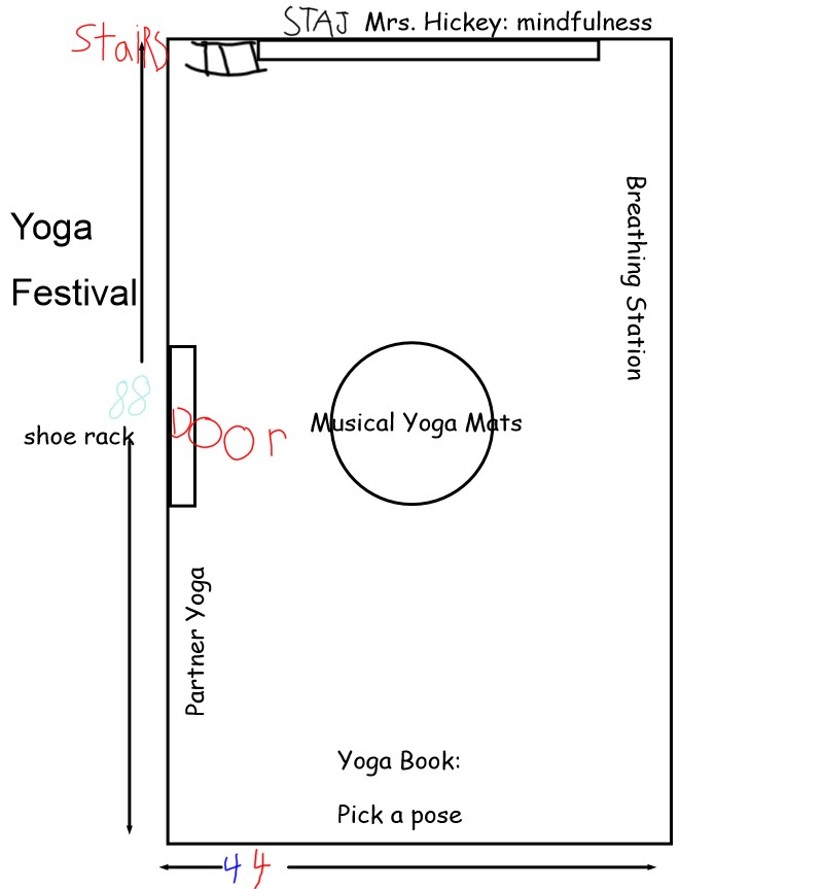
We planned and hosted a yoga festival for Internatonal Day of Yoga.  It was important to plan how we would design the physical layout of the space in the gym.  We used steps to measure the length and width of the gym, then created a sort-of-to-scale map on the SMART Board.

We decided to hold a Timbits and white ribbon sale to raise awareness and funds for how climate change affects polar bears.  We made the perfect white ribbon pin, then measured it with cubes.  We used cubes to measure 100 lengths of ribbon--lots of great lessons about measuring accurately!

Final Thoughts
Implementing project-based learning in your early years classroom will provide many opportunities for developing numeracy skills in authentic, real-world contexts.  This pedagogical approach creates an urgency for counting, comparing quantities, representing numbers, solving problems, estimating, and measuring--students begin to understand why these skills are important and how they are used in the real world.  

Keep your eye on the curriculum.  It is crucial that the teacher has a strong understanding of the provincial curriculum and acts as a facilitator to connect the students' interests with learning outcomes.  Based on observation and the demands of the project, the teacher must provide timely mini-lessons to support students as they build knowledge and develop and apply solutions.  It's all about the teachable moment...be prepared to go where students lead you and don't worry if the skill they need to develop (or at least develop familiarity with) isn't in the curriculum until Grades 3 or 4.  Exposure won't hurt your students, and some will get a lot out of it.  Additionally, it is important for the teacher to be mindful of what outcomes have been addressed through project-based learning and what outcomes need to be developed in future learning experiences. 

Don't try to fit a square peg in a round hole.  Not all project-based learning experiences will teach all numeracy outcomes, so don't try to force it.  Embrace what works naturally with the project, spend more time on the skills that need to be strengthened in your students, and develop other skills in future projects or lessons. 

Document and share learning.  During project-based learning, I constantly capture our learning through photographs, videos, and voice notes that are organized in Microsoft OneNote in a section for each child.  This evidence allows me to determine if students are meeting learning outcomes and provides valuable information for reporting.  For content that I'd like to share with parents, I upload images, videos, and work samples to Seesaw and our classroom Facebook page.  Sharing student learning with families allows them to see how their children are developing important numeracy skills through project-based learning. 

And remember...project-based learning isn't "dessert".  Don't wait until the end of the year when the curriculum has been "covered" to implement project-based learning.  This pedagogical approach isn't an add-on, an extra, or a reward for completing traditional learning activities.  Instead it is an important vehicle for capitalizing on student interests, engaging students in hands-on, real world learning, and developing important numeracy skills.  

Presentation slides and references available here.

Wednesday, May 9, 2018

Simple Ideas for a Successful Junior Kindergarten Program

Lucky you! You get to teach Junior Kindergarten! Four year-olds are so much fun, and not that much different from five year-olds. If you are teaching a multi-age Junior and Senior Kindergarten program, you'll find that most four and five-year olds fit together beautifully.  I've taught Senior Kindergarten since 2008, and variations of stand-alone and combined Junior and Senior Kindergarten since 2010, and I absolutely love it. Here's what I've learned along the way about routines, resources, and activities to develop your program!
Four year-olds are so much fun!
Arrival
Developing smooth arrival procedures makes everyone's day better. I photograph all the steps in arriving in the classroom and create a PowerPoint presentation which we review on a daily basis. As the different slides appear, students complete that task if they haven't done so. I also photograph all the students in the classroom and make a second PowerPoint where we practice our friends' names every morning. Within a couple of weeks, most students are secure in routines and know their friends' names.

To ease separation anxiety (which can be a reality for four year-olds), I recommend a fun and engaging activity at drop-off/arrival time. Encourage parents to say a quick goodbye, as lingering only delays the inevitable tears. I suggest starting your day (or afternoon) with free play in the classroom or discovery learning activities--that way your kiddos are immediately immersed in something they love.
Who can resist spray-painting snow?
How to Start the Day with Discovery Learning 
Begin by teaching the routine of hanging up coat and backpack, handing in clipboard/agenda, putting on indoor shoes, then going to a table to explore and interact with the materials. Discovery learning can target literacy, numeracy, art exploration, as well as science and social studies concepts. Some teachers try to have one tub/tray from each curricular area each week for a total of 4-5 tubs/trays. Discovery learning is play-based, hands on, and promotes inquiry. Learn more here and check out these fantastic ideas on Pinterest.

The start of the year is a great time to begin discovery learning with simple fine motor activities to strengthen the hand skills of your learners—very important for the increasing demands for printing we place on Grade 1 students. See this post to learn more about fine motor activities that are open-ended and encourage exploration. Make time to develop Junior Kindergarten students' fine motor skills--it's a priority at this age.   
Developing fine motor skills as well as an understanding of how secondary colours are created
Once a discovery learning routine is established, activities can become more complex. As a teacher, you can spend the time observing students, capturing evidence of learning through photographs and voice recordings, and taking anecdotal notes. You might choose to position yourself at one discovery tray or roam around the room. I highly recommend Microsoft OneNote to organize all that information—create a page for each student, and you’ll have a wealth of data by report card time. Microsoft OneNote is available across platforms (app and web-based). 

Play
It is imperative that four and five year-olds have an uninterrupted block of free play.  In my classroom, we end the day with nearly 60 minutes of playtime (as recommended by the Council of Ministers of Education of Canada...check out this statement). It is everyone's favourite time of the day. The students and I co-create a variety of play activities based on their interests and I provide literacy and numeracy materials to support the play. Based on what I observe during play time, I teach relevant mini-lessons to move the play forward and develop important new skills. I often pick one student to observe during play, taking notes and capturing images. This yields a wealth of assessment data! Here's an example of what play-based learning might look like in Junior Kindergarten.
Simple materials such as these plastic cups are a popular activity during free play.
Curriculum and Program Development
Don't be alarmed, but there is no formal curriculum for Junior Kindergarten in Manitoba, as JK is not a provincially recognized program. Let me explain my way of thinking about teaching and learning in JK.
-I use the provincial Kindergarten curriculum to guide my instruction in JK with the idea that four year-olds have two years to become proficient in the outcomes
-the recent provincial Kindergarten support document, A Time for Learning, A Time for Joy, is an excellent resource to plan your program
-these documents are also great resources for guiding children's behavior and program development
-opportunities for play-based, inquiry-based, and project-based learning are vitally important and should focus on the students' interests. This has replaced teacher-developed themes in my classroom.
-Kindergarten students (JK/SK) should spend a very limited amount of time on worksheets/workbooks. I include a little bit in my program to strengthen hand skills and prepare them for Grade 1.
-since there are no provincial outcomes for JK students, I regard it as a year to "get what they can". The goal of my JK program is to develop early literacy, numeracy, social, and motor skills. If you are teaching a multi-age JK/SK program, all students participate in all whole-class learning experiences with different activities for learners depending on their level. We are one learning community.
-I work closely with my speech-language pathologist (co-teaching if we can) to strengthen phonological awareness--so important for early literacy!
-just like SK, children come to us at all different points, and it is our job to help them move forward on their learning journey. Some kids will leave Junior Kindergarten knowing all their letters and sounds, others will leave knowing just a few--and both cases are completely acceptable!
-however, that child with very emergent skills will certainly be on my radar very early in the year when he/she begins Senior Kindergarten. And, if I think there is a deeper issue, I will refer to clinical services as soon as possible in Junior Kindergarten.
Connecting with another classroom via Skype as part of a project-based learning experience  
Sample Schedule
8:20-8:25: arrival
8:25-8:45: breakfast snack and discovery learning materials are available, children eat at the circle if they are interested. Discovery learning activities focus on sensory and fine motor development at the start of the year and gradually include literacy, numeracy, and science.
8:45-9 am: morning meeting (reviewing routines and students' names/attendance, counting, songs/poems)
9-9:55 am: whole class learning time (inquiry or project-based, relevant mini-lessons based on play, etc).
-we spend 15 minutes doing Letterland or phonological awareness activities during this block.
-Handwriting Without Tears activities once a week
9:55-10:10: outdoor recess with entire school
10:10-10:30: story time and snack
10:30-11:20: free play, often with an art activity available for students who are interested
-if the gym is available, we might play in the gym for 15 minutes
-we might play outdoors, weather conditions permitting
11:20-11:30: clean up, goodbye song at circle, home time
Creating a menu for the classroom restaurant 
Assessing and Reporting
There are no formal reporting requirements in JK. However, I maintain frequent communication with families through texting, face-to-face conversations, and social media. Since our JK students only attend 0.25, I feel that it is premature to write a report card in November. I invite families to join me for a conference if they are interested or if I have concerns. Otherwise, I write a one-page report card in March. I use a scale to evaluate learning and social behaviors (secure, developing, not yet), then comment anecdotally on strengths and areas to develop,

My comments are based on ongoing pedagogical narrations that include conversations with the child, observations (including photos/videos), and work samples he/she has produced. As previously mentioned, I organize all of this in Microsoft OneNote. More information on pedagogical narration is available in this resource from University of Victoria.

Additional Resources
Ministry of Education, Ontario: this province offers full-time Junior and Senior Kindergarten to all children in the province. Here is their guiding document on Kindergarten.

Junior Kindergarten is a unique and special time in a child's life...enjoy every minute of learning with these fun little people!


Saturday, December 16, 2017

What I've Learned in the First Term of PhD Studies: Workflow and Wellness

It's hard to believe, but the first term of PhD studies has drawn to a close. As my last blog post indicated, September seemed to crawl as I battled a touch of homesickness, so many firsts, and being brave and by myself. Once I put September behind me, October and November have passed in the blink of an eye. I like to think as a slightly older and wiser PhD student, I've learned a few things in the last couple of months.

Figure Out My Workflow: Researching and Writing Papers

This has been a really hard one for me. The first paper I wrote took me DAYS because I didn't have any steps or strategies in place to help me organize my time, my resources, and my writing process. I'm doing so much better with this now, especially after writing three massive papers all due in the past week. Here's what works for me:
-search for articles and books in Google Scholar
-read abstracts of articles, if that is promising do a quick scan of the article, and determine if  it's useful
-copy the title and author, search them in the UVic library catalogue, then download to my computer into OneDrive files labelled by topic
-at the same time, extract the reference information into Mendeley (a free citation manager tool that has a desktop program, a Google Chrome browser plug-in, a Microsoft plug-in, and an app)
-based on the articles I found, I get a piece of chart paper and make a big concept map of all the ideas I want to include
-structure an outline of my paper and decide on the major themes. I set this up in Microsoft Word, not as the actual paper, but as a place to organize information. The themes continue to evolve throughout this process.
-then I begin to read the articles. Anytime I find anything useful, I copy and paste the text, article title, and page number into the correct section of my outline.
-revisit course materials for anything that links to my paper
-print out my outline (because it's just too hard to switch screens), then spend some time reading all my notes and let it sink in
-then I make a concept map that organizes the first section of my paper, then write the first section of the paper. I repeat this process section by section until all the writing is done, extracting citations from Mendeley as I go (the Microsoft Word plug in makes this very easy)
-write the introduction and discussion/conclusion
-draft the abstract
-let the paper rest for a day or two so I can return to it with fresh eyes
-read the paper and edit, at least two times
-read the paper paying strict attention to APA format, looking things up as necessary in my handbook or online
-ask friends and/or my supervisor to review to give feedback on the flow of the paper, cohesiveness of my thoughts, and sharpness of argument
-take a deep breath and submit, then pour a very large glass of red to celebrate!

Workflow: Organizing Class Materials and Notes

The only tools I need to manage course materials and notes are Microsoft OneNote and OneDrive. I've set up a Doctoral Studies OneNote notebook with sections for each course. Each class, I start a new page in the relevant section with notes. If the professor hands something out or shares a useful diagram, I photograph it and upload it to OneNote. This has worked wonderfully well, and when friends miss notes, it's easy for me to share mine with them. The only thing I might do differently next term is organize my course notes by topic instead of date, as it was sometimes difficult to remember what date we discussed something. As OneNote is a cross-platform tool, I have the app on my iPhone, my Surface, and my laptop. Everything syncs across devices, so I always have everything I need.
Additionally, I organize all articles, course outlines, and handouts in Microsoft OneDrive. I have a folder called Doctoral Studies and a sub-folder for each class. Like OneNote, OneDrive is available on all my devices, and it is really easy to share documents and work collaboratively with my colleagues.

Office 365 is free for educators and includes the tools I rely on so heavily. All you need is an education email address (your school division or university one will work) and you can start using it for free! Learn more here.

Leverage Your Resources

I'm fortunate to be surrounded by amazing friends, colleagues, and mentors, and I know that seeking their support is key to my success. It's sometimes hard to make myself vulnerable and share my work with them because I don't want them to think it's bad. But I know the only way I'll improve is with feedback, and sometimes I can't see my own glaring errors as I've spent so much time working on the paper. Sending my first paper to my supervisor for review was a very hard and scary moment. But her feedback was kind as well as constructive, and I learned a lot.

My best friend Leah and I like to do as much as we can together and we have very similar educational interests. It's a bit harder now, but that's where Skype has been a great tool. We used Skype to review my paper together last weekend; sharing the screen so we could both see the paper at once.

You Won't Survive Without Your Cohort

My department chair at Brandon University advised me that my relationships with the people in my cohort would be critical to my success, and he was absolutely right. On the first day of my first class, I made a new friend, and I've added to that number throughout the term. I took it upon myself to organize a cohort study group and we meet every other Wednesday before one of our classes. I used Microsoft Forms to find a time and location that worked for the most people. Sometimes only a few people show up, but it is an important opportunity to discuss the readings and assignments, ask questions, and listen to each other.
Image may contain: 11 people, people smiling, people standing
Image may contain: 11 people, people smiling, people sitting, table and indoor

Take Time for Wellness

Time spent in nature and on my yoga mat kept me sane during the crazy busy-ness of final papers. I keep my yoga mat unrolled by the table where I work, and every hour I stop what I'm doing and spend a few minutes practicing...often just a few cat-cow stretches, downward dog, forward folds, and some twists. Additionally, I take in a studio class most days at One Yoga, Alive Mindbody (barre--my new passion) or Fernwood Yoga Den, and occasionally Moksana and Moksha. Moving my body and focusing on nothing but my breath and intention are so therapeutic for me.  After finishing my a 6000-word paper, I was exhausted and overwhelmed, but thought I should carry on to my next paper. This proved to be a really bad idea as I was unproductive and tearful and incapable of doing anything. I used my Mind Body app to find an upcoming class and headed to Moksha for a 90-minute warm yin class. It was the best thing I could have done, and as my mind and body relaxed in savasana, I was hit with the most fabulous idea ever for structuring my next paper. I left the yoga studio feeling inspired, and went home to write half the paper in one sitting. I got an A+, and I firmly believe that I wouldn't have produced such great work without taking care of myself first.
Image may contain: indoor
Love yoga barre classes at Alive Mindbody!
Most days I visit my nearby beach which is only five minutes away. The fresh ocean air and refreshing breeze always energize and refocus me. There is a great trail that wanders from Willows Beach to Cattle Point that I love to walk along. The beaches are open to dogs beginning in October, so I often get to pat dogs and visit with their owners. Social interaction, animals, and fresh air always make me feel so much better.

And the first term is in the books...
My first term of PhD studies went so much better than I expected... I'm really pleased with my marks, the program and my supervisor are both excellent, and I love my new friends and yoga community. Happy to be back in Manitoba for the holidays, and excited to see what the second term has in store!

Thursday, March 2, 2017

Walking for Polar Bears, Part 1: When Little Kids and Big Kids Collaborate

If you're a regular reader of this blog, you'll know that my littles love helping animals. Before Christmas, my JK students planned and executed a fantastic Reindeer Rescue Art and Craft Sale to adopt five reindeer from World Wildlife Fund Canada. And when they returned from Christmas holidays, their interest in and desire to help polar animals hadn't faded one bit. So when I received an email from WWF Canada about an upcoming polar bear walk (founded by a 7 year-old boy a few years ago), I knew without a doubt they'd be interested. What I didn't realize was just how big this project would grow to become and all the stakeholders who would join us!

I knew that my SK students had felt a bit sad when they heard all about the JK's reindeer project from them at daycare, so I decided that both JK and SK classes would be a part of our new polar bear project. The JKs asked the SKs if they would be interested in working on a polar bear walk project, then the SKs decided to Skype Mrs. Obach's Grade 1 class and ask them if they would like to join us too. When this project began in January, I had just started teaching pre-service teachers in the Faculty of Education at Brandon University. My kindergarten students were very interested in my "big kids", so I asked them if we should invite the big kids to help with the project. My JK class made a little video that we shared with my BU students and they agreed to work with us too! My big idea surrounding the project had two components: my little ones would engage in project-based learning to develop important skills, meet curricular outcomes, and make a difference in the world. My university students would monitor the evolution of the project through weekly updates and collaborate with our classes to plan a polar bear walk, increasing their comfort level with project-based learning. It worked beautifully!

The most powerful tool we used for our collaborative project-based learning was Microsoft OneNote (a web and app-based digital binder/notebook tool). With my kindergarten learners offering suggestions for the sections, I created a notebook for us to document and share our learning and plan our polar bear walk.  We shared our OneNote with Mrs. Obach's class and both of us were able to contribute a variety of content--photographs, links to resources, videos, and text. We were able to use the pens on our SMART Boards to print information into the OneNote as well, which was great for our beginning writers. Each day we began our learning by reviewing the facts and resources in the OneNote notebook, and it was a game-changing way for us to collaborate on such a large project. At university, I regularly shared the notebook to show the big kids what was happening in the project and discuss the learning taking place. This was the perfect way to build my big kids' knowledge of project-based learning, and demonstrate how it is such an effective approach for meeting the needs of diverse learners.
As it often is, knowledge construction was a key component of the project. We needed to learn all we could about polar bears, understand what was happening in Canada's north, and find out how we could help them. We read books and watched videos, recording important facts in our OneNote. A video call with Andy McKiel and Mrs. Obach's class was especially enlightening. Mr. McKiel had spent a week in and around Churchill and had a wealth of knowledge and stunning photographs to share with us. As always, Skype was an important tool in our project-based learning. We had regular video calls with Mrs. Obach's class to share our knowledge and plan the walk.
My SK students used Duck Duck Moose's Draw and Tell app to share their emerging understandings of polar bears. Check out the sample below.
As we built understanding about polar bears and the challenges they face, our project splintered in two directions. The JK students were really interested in investigating why the ice is melting, and I was really impressed by their insights. (Why don't we just use cold water and make more ice for polar bears? If the ice is melting, it must be because it is getting hot in the Arctic. Why is it getting hot?) We did some research and learned that garbage and pollution are making "bad air" that is causing the earth to heat up. These higher temperatures are melting the ice. The JK students made the connection that helping the earth helps polar bears! They decided to make a video to encourage others to help the earth to help polar bears. Green Screen by Do Ink and Pixabay were invaluable in creating our video. We included the big kids from BU in our video as well as the SK class, and we used Do Ink to green-screen a variety of copyright-free background images from Pixabay.

The SKs decided to scale up our impact and raise more money and awareness for polar bears. Since time was of the essence, I went with their first idea--let's sell Timbits! We decided to sell two Timbits and a white ribbon pin that people could wear to show their support of polar bears for a toonie. In 20 minutes, we sold out and raised $100 to add to our polar bear walk fundraising! Although this was a quick little activity, we fit in a ton of learning.
-shared writing to draft a letter home to families
-printing signs
-surveying classrooms to find out how many students in each and recording the numerals
-cutting our notes in half, counting the correct amount for each class, and labelling them with the correct number and grade
-using non-standard measurement (cubes) to measure the length of each ribbon
-developing scissor skills as we cut 50 pieces of ribbon
-oral language skills as we worked at our sale
-counting the toonies by 2s and loonies by 1s to see how much money we raised
Throughout this process we planned our walk...which was not without a few challenges! Learn more in a future post.