Monday, October 10, 2016

Teacher Wellness Series, Part 3: Four Ways to Develop an Attitude of Gratitude

Gratitude. It's pretty much the simplest, most powerful thing you can practice that impacts you mentally, physically, and emotionally. And now is the perfect time of year to share how you can cultivate an attitude of gratitude with only a few simple steps. But first, a little bit of background on my personal gratitude journey.

Thanksgiving is a holiday that has always been really meaningful to me. I'm the person at our family's dinner table that insists we take a moment to share what we are most grateful for in our lives--as my dad and uncles roll their eyes and grudgingly participate. Last year, for the first time ever, I was away from my family on Thanksgiving...I was feeling a bit sad, eating a burger and drinking a glass of wine by myself in an American restaurant (the closest thing I could find to home) in Zagreb, Croatia.
And it seems that in the blink of an eye, it's Thanksgiving again, and this time I'm at home in Kenton, Manitoba. The past 14 months were probably the most amazing and eventful that I've ever experienced, leaving me with a lot to be grateful for today.

-family, friends, and colleagues who supported my plans to take a year away and try something new
-the wonderful people I met, many who have become friends, in the last year
-learning that YES I could look after myself and rely only on myself, no matter where I was in the world
-feeling scared sometimes but always feeling alive
-learning that it's okay for things to change and that it will probably all work out in the end
-seeing and experiencing different countries, their people, and cultures
-so many beautiful sights and moments that I've lost count
-becoming a yoga teacher and expanding my personal yoga practice
-the yoga community that has emerged in my hometown and surrounding communities and the many yogis who support my weekly classes
-having a career, students (big and little ones), and families that I love
-being well and healthy, and having the tools to look after myself and positively impact the well-being of others

But gratitude isn't something I practice only on Thanksgiving. I've had a daily gratitude practice for over two years now. For years, I had heard Oprah refer to gratitude, but after reading about all the benefits of living gratefully in The Happiness Project by Gretchen Rubin and Thrive by Arianna Huffington, I knew that I needed to make gratitude a regular part of my life.
Image result for oprah the single greatest thing
Book Cover
 Grateful people experience many physical, mental, emotional, and spiritual benefits--such as reduced stress, more mindful living, improved immunity to illness, more positive relationships, optimism, and greater happiness. This Huffington post article describes many benefits to cultivating an attitude of gratitude. And if you are someone who believes in the Law of Attraction (like attracts like), grateful people attract more abundance and positivity into their lives.

So how can you develop your own daily gratitude practice? There are many ways to practice gratitude, but I think it's most important that you find a way that works for you--something pleasant, simple, and quick, that you can easily integrate into your daily routine and/or yoga practice.

1) Make a happiness jar: cut up some squares of paper and get a big jar. At the end of every day, write down the happiest moment of your day or something that you are grateful for. Deposit the slip of paper in the jar and repeat each day. If you are feeling down, scoop out a handful of papers and read about your happiest moments--a proven mood-booster! Here's my happiness jar pictured below. What will fill your happiness jar? Get inspired with this Pinterest board all about happiness jars.

Teacher tip: have each student start a happiness jar and add to it daily or weekly. Little ones can draw a picture of their happiest moment, big kids can write a couple of sentences. A great writing project with mental health benefits too! Or, consider a class happiness jar that everyone contributes to on a regular basis.

Tech connection: use your classroom Instagram account (early years) or students' Instagram/Twitter accounts (middle/senior years) to create virtual happiness jars. Students capture a photograph of happiest moments and share with the hashtag #happinessjar. Let's flood social media with positive messages!
2) Gratitude journaling: you might already journal regularly, but if you don't, starting a gratitude journal is an easy way to introduce reflective writing into your daily routine. Buy a pretty journal (Winners has so many nice ones for less than $10), and at a certain time each day (before bed or following your morning yoga practice), jot down a few things that you are grateful for. Don't force it, and don't write down the things that you "should" be grateful for. The more novel, the better. I've been grateful for everything from having a clear complexion to nice smooth, straight roads to drive on!

Classroom connection: start gratitude journals with your students, or make it something that is part of their regular weekly writing...maybe every Friday they write an entry about what they are grateful for. Little ones can draw pictures and label them, or teachers can lead the class in a shared writing activity to help everyone count their blessings.

Tech connection: there are a few apps in the App Store if you'd like to do gratitude journaling on your phone. I use this one--check it out!

3) Get a partner in crime: make a commitment with a friend to start a daily gratitude practice and text each other what you are grateful for each day. My best friend and I did this for over a year when we first started practicing gratitude, and it was a wonderful way to be accountable. If one of us forgot, receiving the other person's text was all it took to text back with our own list.

Classroom connection: if you teach little ones, pass a special object around the circle as each child shares something they are grateful for. Sometimes I make gratitude my "password" to get out the door for recess or at the end of the day. Older students may not want to share what they are grateful for with their peers, so consider a quick gratitude exit slip at the end of the day.

4) Make it part of your yoga practice: it's easy to feel grateful as your yoga practice draws to a close and your body and mind are flooded with feelings of contentment and relaxation. As I roll up onto my mat after savasana, I take a few moments to reflect on what I'm grateful for that day. I close my eyes and breathe deeply as different ideas come to mind. Yes, a daily gratitude practice can be this simple when it's part of your routine.

Once gratitude becomes part of your life, you'll find yourself feeling grateful throughout your day--sometimes about the smallest things. Savour these moments and share them with others. Cultivating an attitude of gratitude is simple, powerful, and rewarding, with a huge impact on teacher and student wellness. You'll thank yourself for starting today!

Sunday, September 25, 2016

Teacher Wellness Series, Part 2: Morning Rituals to Start Your Day Off Right

What is a morning ritual? A morning ritual is a series of habits, acts, or practices, usually completed in the same order, day after day. And these rituals are vitally important--the way we begin our morning sets the tone for the rest of our day. A calm, relaxed, and nourishing morning ritual empowers you to deal with the inevitable challenges you'll encounter, reduces stress, increases productivity, and helps you live more intentionally. And getting out of bed is a lot easier when you have something to look forward to! Developing a morning ritual is a very personal thing, and one that evolves over time to be responsive to your needs. This blog post is a window into my current morning ritual that will hopefully inspire you to develop your own.

Morning Stretch: sometimes I do a few yoga poses before I even get out of bed, slowly introducing movement and stretching to my body after hours of sleep. This morning sequence will help you transition from sleep to awake and make it easier to get out of bed.

Apanasana: hug your knees into your chest and gently roll from side to side
Happy Baby: hands come to the outsides of your feet as you bend your knees, bringing them wider than your torso. Soles of the feet face the ceiling as you lengthen your tailbone down to the mattress. You can rock from side to side.
Supine Twists: extend your arms out to the sides in a t shape as you hug your knees into your chest. Let your knees fall over to the right side as you look over your left shoulder. Ground down through your shoulders, and use your right hand to press your knees closer to the mattress.
Bridge: let your arms rest by your sides as you bend you knees and place your feet flat on the mattress. Gently push your hips up toward the ceiling, pressing down through your hands.
Fish: while lying flat on your back, bring your hands underneath your hips, palms down to the mattress. Lift your heart and chest above your shoulders (think pushing from your bra strap area) and stretch your head back.
Seated Forward Fold: sit up, extending your legs in front of you. Inhale to lengthen your spine, then exhale as you fold forward, reaching for your shins, ankles, or toes.
Child's Pose: sitting up, bring your sit bones to your heels, pausing for a few breaths in virasana (hero's pose). Push back into child's pose, keeping your legs together or taking your knees as wide as your hips. Arms can extend over head, using your hands to push your sit bones a little closer to your heels.

Lemon Water: for years I've heard about the benefits of drinking warm lemon water first thing (before eating) in the morning. This hasn't been natural for me as I'm always ravenous when I wake up and want to go straight to eating breakfast. However, I've had more success with this practice since I started squeezing the juice of half a lemon into a cup of water the night before. Then I just microwave it for 90 seconds and drink it while I prepare my breakfast. You can even drink it at room temperature if you prefer. So what's the big deal about warm water and lemon?
-helps constipation
-prevents urinary tract infections
-boosts your immune system and fights off infections (all that vitamin C!)
-reduces inflammation in your body
-cleanses the liver
-promotes weight loss
-boosts brain and nerve function
Read more here!

Goal or Intention Setting: as I eat breakfast, sometimes I write down 5 things I'd like to complete during the day. Taking the time to write down your goals for the day takes them from abstract to concrete, increases your accountability, and makes it more likely that you will actually accomplish them. And goals don't need to be about housework or your job...including goals such as drinking water, pausing to breathe when you feel stressed, or going for a walk at noon make your self-care and wellness a priority.

Additionally, you might choose to set an intention for your day. An intention is a quality or attribute that you wish to cultivate or continue to work on. Intentions such as patience, calm, or kindness are powerful when recalled throughout the day. If I am working on a certain intention for a period of time, I make it the lock screen on my phone. I use a picture that I really like and use a text on photo app (such as Rhonna Designs) and create something that is a beautiful reminder every time I check my phone. I sometimes do this with inspiring quotations as well.

Inspiring Quotations: I LOVE inspiring quotations. I have books of them and I'm always pinning them on Pinterest. After finishing breakfast, I take a cup of tea to my yoga mat and I often choose an inspiring quotation for the day or week. One of my favourite inspirational books is "Brave Enough" by Cheryl Strayed. No matter what page I flip to in this little green book, there is always something that resonates with me. As I mentioned previously, I sometimes turn my favourite quotations into an image for the lock screen of my phone. Or if you'd rather do it old school, print them on a Post It note and stick them to the dash of your car!

Yoga Practice: now that I'm on my mat with a cup of tea and inspiring thoughts in my head, I begin my physical yoga practice. Although I generally practice in my living room, it's important for me to create a tranquil atmosphere. I either burn incense or plug in my Saje diffuser with an essential oil or oil blend. Depending on my mood, it might be a grounding, energizing, uplifting, or calming scent. I am pretty much obsessed with my aromaOm diffuser...so much that I just bought a second one so that I didn't have to keep moving it around the house with me. Saje diffusers are wonderful for cleaning the air and fragrancing your space. My favourite essential oil blends from Saje are Yoga and Tantra, and I always love lavender essential oil.

My morning yoga practice always begins with breathing exercises, cat/cow, child's pose, some gentle twists and side body stretches, and sun salutations Sun salutations are wonderful for warming the body and working nearly every muscle group. After my sun salutations, I do a combination of flow sequences and static poses depending on what my body needs. In order to move forward with my practice, I try to work on a pose that is challenging for me. I find that by practicing it daily, I see a lot more growth and feel like I'm getting somewhere in my practice. Since I'm a yoga teacher, I usually make up my own sequences. If you're not comfortable with that, an online class might be a better option for you. See this post for free online yoga resources.
Above: hard at work on Warrior III as my challenging pose of the day

After a nice long savasana, I sit in meditation for a few minutes and practice gratitude (learn more about meditation and gratitude in future posts). Then I open my eyes, ready to begin my day...always feeling stronger, calmer, and more quietly energized than when I got out of bed. Teaching is a very demanding profession, and we owe it to ourselves and our students to take the very best possible care of ourselves. Developing a morning ritual that feeds your soul is an important part of being the best teacher you can be each day.


Monday, September 19, 2016

Teacher Wellness Series, Part 1: Simple Tips and Free Resources to Start Your Yoga Practice

If you are a regular reader of this blog or follow me on social media, you'll know that yoga is a huge part of my life. For my entire adult life, I dabbled in the physical practice of yoga on and off, but only in the past two years have I developed a daily practice and certified as a yoga teacher. I often hear from people that they'd love to start doing yoga too, but they're unsure of where to begin. This blog post is for you!

If you live in a rural area, yoga studios are few and far between. For my urban friends, sometimes it is just really intimidating to show up at a yoga studio as a complete beginner. Not that it should be--I've found yoga communities around the world to be very warm, welcoming, and supportive. But sometimes you just aren't sure about the level of the class, and practicing beside someone who can do a headstand when you aren't sure what child's pose is can be daunting indeed! If you have access to a studio, consider signing up for a "Foundations of Yoga" or beginners' class. Classes like this will slowly take you through the basics and ensure that you have a thorough understanding of what key poses feel like in your body. If you're feeling some anxiety, it's a good idea to talk to the instructor first. Ask if he/she is comfortable with providing options for yogis of all abilities and if the instructor recommends his/her class for new yogis.

A few private sessions are not as pricey as you'd think and can go a long way to helping you feel comfortable on your mat. I began my yoga practice with private sessions with a yoga instructor and my best friend. It was a wonderful introduction to the practice and made me realize that yoga was key to managing stress and taking care of myself. But my private sessions were only once a week and I wanted to learn more on my own and practice on a daily basis. I had a couple of friends who mentioned 30 Day Yoga Challenges, so I decided to begin one on my own. Since then, I've discovered a number of great online tools, classes, and challenges.
Above: starting my first 30 day yoga challenge nearly two years ago with my $15 mat and my sheltie for company!

My Favourite Free Yoga Resources

30 Day Yoga Pose Journey: The Journey Junkie
One pose a day is delivered to your inbox, beginning with simple poses and moving to more advanced. There's a nice explanation of the benefits of the pose and a short tutorial video. This is an excellent way to build your practice, one pose at a time!

Yoga with Adriene: 30 Days of Yoga 
This was my first 30 day yoga challenge and it had a huge impact on me. Although Adriene can be really chatty and somewhat annoying, she does know what she's talking about. She really encourages you to listen to your body and "find what feels good". She has tons of free content on her YouTube channel, and you can sign up to have a weekly class sent to your inbox.

Erin Motz: Bad Yogi Official Blog
Erin Motz is my favourite online yoga instructor, and I did her 30 day yoga challenge after I completed Adriene's. She is very down to earth and accessible for new yogis, but her videos have a nice level of challenge to move you forward in your practice. If you visit her blog, she has lots of free content, and you can also sign up to receive a free weekly class emailed to you on Mondays. Erin is a huge figure in yoga counter-culture and maintains that we need to take the snobbery and pretentiousness out of yoga--yoga is for everyone and every body type.

Do You Yoga
Do You Yoga is a paid subscription site, but they have lots of great free classes, challenges, and articles too. This is a great resource and definitely worth a visit--they frequently have weekly and monthly challenges that you can access for free.

What supplies do you need to get started?
Truthfully, you can practice yoga on the floor in your bare feet with no props or mats. However, it is more comfortable with a mat. If you're not sure that yoga is for you, I'd recommend picking up an inexpensive mat at Winners for $15. If you continue to practice and want something more supportive, I'd recommend purchasing a mat from Lululemon or B Mat. Both are Canadian companies who make excellent products. I love Lululemon's 5 mm mat...it's super cushy and grippy.

I would also recommend two blocks. Again, you purchase them for about $7 each at Winners. A yoga strap isn't a must (you can always use a scarf), but a strap is very inexpensive and I always like to have the proper equipment. A strap is invaluable in seated forward fold if you can't reach your toes yet, and as well as variety of other poses! Lululemon makes a great strap that doubles as a carrier for your mat.

Important Points to Remember
They say it takes weeks to develop a new habit, so try and carve out a bit of time each day to explore yoga--even 15 minutes! I prefer to practice in the morning--it is a wonderful start to my day and no matter how crazy my day turns out to be, I've already got my yoga in! Make yourself a cup of  tea and put some music on...make this a special time for yourself (read more about this in a future post about morning rituals).

Some days you just won't feel like doing yoga. For those times, I have a rule that all I have to do is get on my mat and do child's pose (still wearing my pajamas). Sometimes I'll stay in child's pose for ten minutes, but usually it feels so nice that I'm inspired to do more. It's getting on your mat this is the important part...staying there is easy!

Listen to your body. If it hurts, don't do it! Pay attention to what your body is telling you. Some discomfort in a new pose is normal, but pain is not. And always make sure that your body is warmed up before increasing the demands on it!

Lastly, don't forget to breathe. Linking breath with movement is what makes yoga the transformative practice it is. And don't forget to be kind to yourself and enjoy every step of this new journey you have started!

Tuesday, August 16, 2016

You Asked, Kindergarten Diva Answers! Second Edition: The Beginner's Guide to Yoga in the Classroom

How do you start doing yoga in the classroom? 

When I introduce myself to my class every year, I use a "teacher box". It's a medium-sized box full of some of my favourite things. For example, it includes an empty bottle of perfume, a cardboard cutout of a pizza slice, an empty shopping bag, a yoga strap. and a dog leash. I tell my students that this box contains special items that tell things about their teacher, and I ask them to guess what each item means. When I pull out the yoga strap, it leads naturally into a discussion of what yoga is. With young children in a school setting, yoga poses (asanas) are the most accessible and easily recognizable component of yoga, and I always begin there. Next, I might show some pictures of me doing various yoga poses and talk about why I'm doing each one (strong arms, improve balance, feel brave, to help me sleep or relax, etc.)

You might choose to share a book about yoga from the Peaceful Piggy series. If you download this book digitally to an iPad or iPhone, you can Airplay it to your Apple TV and project it. Reading the paper copy is always great too. I love the Peaceful Piggy series as it simply and engagingly explains yoga poses and meditation to kids. If you don't want to purchase the books, there are YouTube videos of people reading them, but I'm not sure about the quality. Another book to check out is Moody Cow Meditates if you wish to explore meditation with children.

A couple of my teacher friends do a yoga pose of the week as part of their morning routine. After children hand in their planners and do their morning jobs, they head to the carpet (or wherever) and start practicing the designated yoga pose. You could teach this pose on Monday, or you could have a video playing on the SMART Board for children to follow along with. One of my friends really likes Go Noodle's Maximo. This part of the site features short yoga pose videos that are very accessible for kids.

The wonderful thing about yoga is that it can be woven into anything you're doing in your classroom without making a big deal about it.

Yoga in your gym class...or as a movement break!
Play musical yoga mats: it's just like musical chairs, but we set up the mats in a circle and move from mat to mat. I like to mix up how we move--walking, hopping, running, crawling, etc. When the music stops, everyone finds a mat and one child names a yoga pose for everyone to do. Or, the teacher could name a pose, or a child can choose one from a pile of yoga pose flashcards.
Play yoga frozen tag: when children are tagged, they strike a yoga pose (own choice, teacher's choice, or choose a flashcard).

Partner yoga: put some mats down on the gym floor (the thick ones stuck to gym walls work well) and introduce one partner yoga pose at a time. Kids of all ages (and adults) love partner yoga! Check out these ideas here.
Simon Says: use this old favourite game with yoga poses instead!

Here are great resources with more ideas: Yoga Games for Children  Yoga in My School 

Retell stories using yoga poses!
Almost any story can be retold with yoga poses, but stories about animals work especially well. We love using Jan Brett stories as they always contain a wide variety of animals. Learn more here about our retelling of The Mitten with yoga poses. The Snowmen series by Caralyn Buehner is great too, and it's easy to make up the poses to represent the characters/actions WITH your students (you don't need to be the expert). Namaste Kid has many scripts for retelling stories with yoga poses.

Indoor recess fun!
Check out Cosmic Kids for a great indoor recess or movement break activity. Project one of their videos on the SMART Board and allow kids to physically participate in the story they're featuring.

Points to consider
-yoga with kids will NEVER look like an adult yoga class, so get all ideas of perfection and silence out of your head. First of all, it's really important to use the kids as your #1 resource and allow them to co-create yoga sequences with you. "What pose would feel good next?" "This story has a rabbit in it. What pose could we do to be the rabbit?" "Let me hear you meow and moo as you do cat/cow!" Yoga with kids is fun! If it's not fun, they won't want to do it.
-not all families support the idea of yoga in the classroom. Always let families know that you are planning on integrating yoga poses and movement into your classroom. Explain how yoga enhances learning and teaches important skills such as focus and self-regulation (in addition to physical health benefits). Sometimes families confuse yoga with a religious practice. Yoga is spiritual but not a religion, and I wouldn't recommend including that spiritual side in your classroom anyway. Make sure families understand that you will be focusing on the physical poses of yoga and address any questions or concerns they might have.
-and always make sure your administrator is aware of what you're doing in your classroom and supports it. The best way to accomplish this is with a quick overview of the many ways yoga enhances a child's ability to learn!

How do you encourage students who don't want to try yoga?
As long as your families and school administration are supportive of yoga in the classroom, I would never present it as a choice. It is yet another learning activity that we all engage in together in our classroom. Occasionally I would experience reluctance from some of my little boys, and I would explain that yoga makes us better at all of the sports we like to play. Hockey players who crosstrain with yoga were a powerful motivator for them. If a child completely refused to do yoga, I'd tell them to sit quietly on their mat. Usually when they see how much fun the other kids are having, they are reluctant to miss out.

And don't forget...
Introducing yoga to your classroom practice is a great way to teach kids important tools to support their learning and increase their ability to cope with stress. I really wish that yoga had been part of my life from a young age instead of something I turned to later in life. Just remember to make sure everyone is aware of your plans, start small by choosing one thing to try, share your successes with your staff and families, allow children to co-create, and HAVE FUN! 


Monday, August 15, 2016

Leap and the Net Will Appear: My First Ignite Talk

Preparing and delivering my first Ignite talk was a huge undertaking! And I don't think I've ever been more nervous about speaking in front of a crowd. But I'm pleased to say that it went really well. A big thank you to Andy McKiel and the organizers of Riding the Wave in Gimli for asking me to share my yogic journey. 


Friday, August 12, 2016

Making a Maker Faire...and a Yoga Festival Too: Part 1

If you are a regular reader of this blog, you'll know that my kindergarten students love yoga. They've been passionate about it since I first started teaching them in December. In May, I discovered another thing that they really love, and that is making. After attending Riding the Wave in Gimli, Leah Obach and I were inspired to do more with maker space in our classrooms. Like most of our projects, it soon took on a life of its own with our young learners in the driver's seat. 

Leah and I introduced the concept of making one morning in our weekly Skype call, We discussed how everyone is a maker, and shared some of the things that Leah and I like to make. Boys and girls then shared with each other what they liked to make, and we made a promise to each other to try maker space that coming week and report back to each other the following Friday. This Skype accountability with our partner class is key in ensuring that we follow through with our plans! 

We assembled materials with a visit to the Co-op for cardboard boxes and scoured the supply room and the recycling bins. For added inspiration, we viewed Caine's Arcade on YouTube, which they absolutely loved. After a discussion of safety and scissor/stapler use, I let them loose. Take a look at the high levels of engagement, creativity, and problem-solving in this short video! 

Very quickly, making became my young learners' favourite thing to do. At Miniota School, our buses drop off half an hour before school starts. If I wasn't in the room when my students arrived, I would find them already making, choosing to work on their creations instead of go outside and play or eat breakfast. It was impossible to contain their enthusiasm....or the mess that was taking over our classroom!

Here is what I learned about making with young children:
-safety comes first (for example, no stabbing into boxes with scissors when someone is inside the box!)
-provide long blocks of time a couple of times a week, as once they get started they don't want to stop. And, I'd rather clean up a huge mess once or twice a week then a smaller mess on a daily basis.
-don't place limits on what they can make
-don't do it for them
-photograph their creations 
-embrace the chaos and marvel at all the amazing learning happening! 
-develop a system for organizing and storing supplies (one teacher I read about uses green dots for materials the students have free access to and a red dot for materials they need to ask to use)

Leah's students were experiencing the same passion for making, and of course this turned into another collaborative project. Our boys and girls decided they wanted to host a maker faire where they could make things together, and teach other people about making. My students took the lead on this project, and we decided to host it in our school, as Mrs. Obach's class took the lead and hosted the Code-a-thon. As both of our classes also love yoga. we made the decision to host our maker faire on International Day of Yoga so that we could have a yoga festival in the afternoon. 

As always, we followed a project-based learning model--students taking the lead, collaborating and creating with technology, and involving multiple partners. As teachers, Leah and I helped the students to "uncover" more of the curricula, providing interdisciplinary lessons as needed to help the students move the project forward. Regular Skype calls allowed us to each take on different tasks, report back to each other, and make decisions about the maker faire and International Day of Yoga Festival. 

We used shared writing to compose this letter to our principal:

Although we are young, we love yoga clothes. and we decided to ask Inner Fire and Lululemon if they would support our yoga festival. This was an excellent opportunity to talk about persuasive writing, and we developed a little presentation using Haiku Deck. Inner Fire was amazing, responding instantly and providing prizes and a free yoga tank for me! Wow! 


Hello there Inner Fire! -  

Our next job was to create invitations. We used Microsoft Publisher to make these simple cards, and also exported them as a PDF to email to faraway guests. QR codes on the back of the invitations provided links to movies and more information. 
nspires;  

We made an extensive guest list and addressed and decorated the envelopes. We used tally marks to see how many stamps we would need to buy and how many could be hand-delivered. 


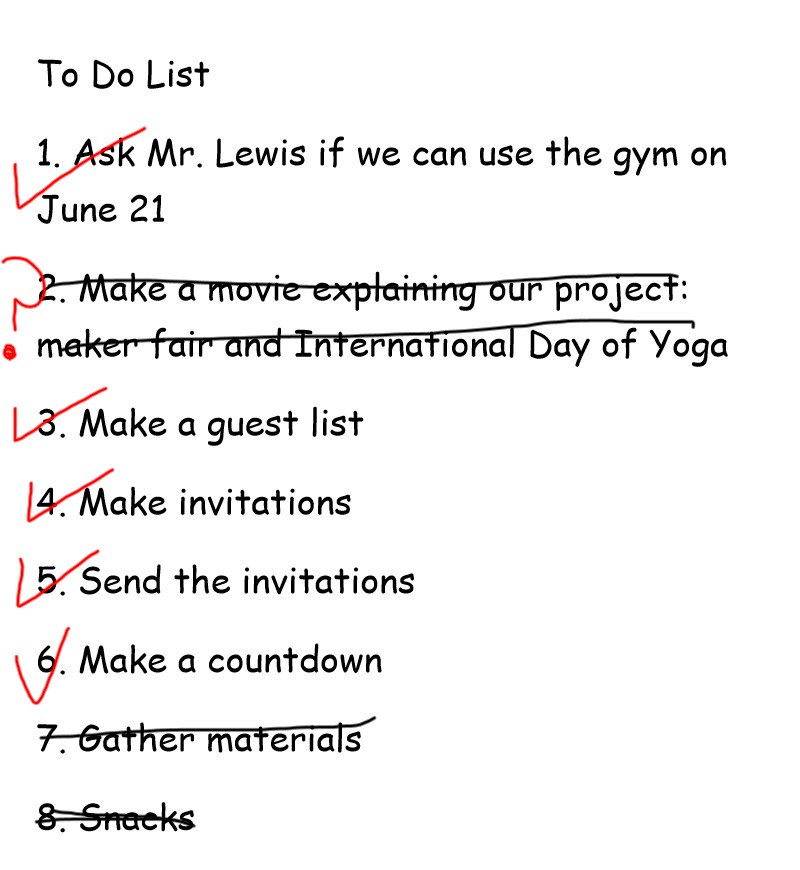
As for every project a to do list guides us and acts as a plan. 

With our Grade 1 friends, we brainstormed a list of materials that we wanted for making. We divided up the list, making decisions about who was responsible for getting the items. We also put out a plea on social media for donations. 

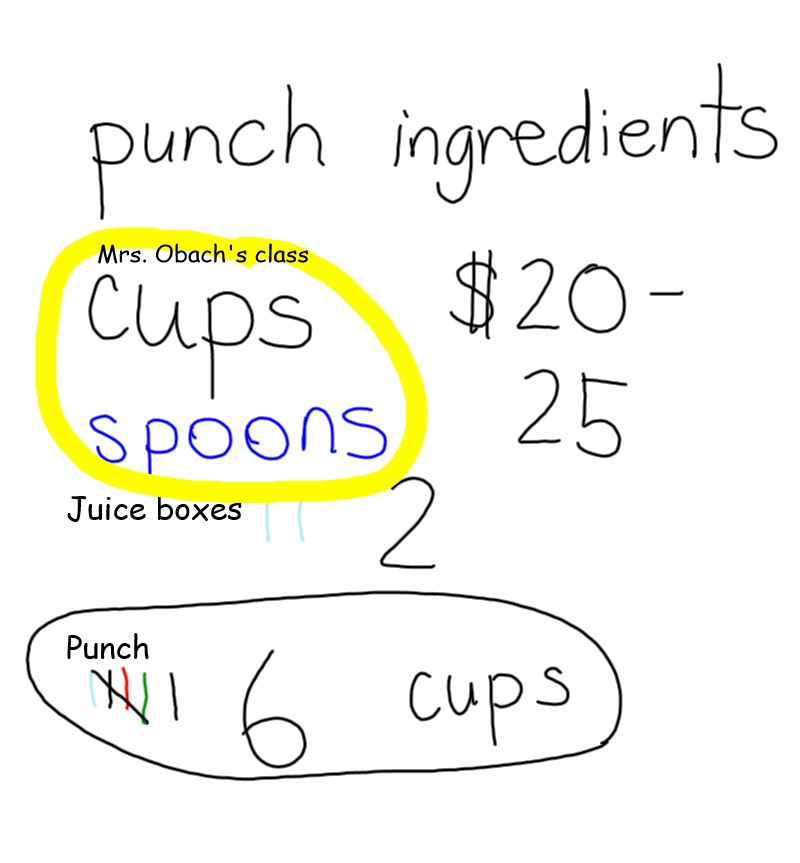
We collaboratively developed this schedule for the day and a list of healthy snacks. We decided to ask our parents to donate snacks, and they were wonderful to provide everything we needed. We asked Mr. Lewis (our principal) for a budget to buy ingredients to make punch. This led to some excellent math learning.  

We walked to the Co-op and shopped for supplies. 


We made playdough for one of our maker activities at the maker faire.

One of the activities I was most excited about was mapping the gym, as it brought in social studies, numeracy, and ELA outcomes in a very authentic way. We paced out the gym, counting our steps, then drew and labelled this map on the SMART Board. This map was later posted in the gym to help us set up. 

Developing a job chart was much anticipated by the boys and girls! They decided that the boys would act as greeters at the door and the girls would preside over the guest book and snack table. 
We were also lucky enough to enlist the help of our Grades 7/8 class and Hamiota Collegiate student council (some of whom attend my yoga classes in Kenton) for our yoga festival. 
And after a frantic last day of preparations, the gym was set up and we were as ready as we were ever going to be! Stay tuned for a second post about the actual event, and tips for running your own maker faire and yoga festival! 

Tuesday, June 28, 2016

Avoid the Summer Learning Slide!

If you’re like me, you can’t believe that June is already here. And despite the craziness of assessments, reporting, awards day ceremonies, field trips, and impending good byes to students, my thoughts are already turning to my favourite season of the year. Summer! Bikinis and beaches, airplanes and backpacks, golf clubs and green grass, patios and cool drinks, and professional learning. That’s right—professional learning. It’s not only students who can experience summer learning loss!

The glorious months of July and August are a rare opportunity for relaxation and adventure, but summer holidays also gives educators a chance to engage in self-directed professional learning. With ten months of busy schedules and mandatory professional learning days, pursuing our own educational interests is an indulgence many of us we feel we can’t afford. This summer I challenge you to choose a topic you are passionate or curious about and pair some professional learning with your favourite summertime activity. Put a few of these summer learning hacks into action and avoid the summer slide!

Summer Fun
Summer Learning Hack
Soak up the sun
Hold a frosty drink in one hand and an educational book or journal in the other. Challenge yourself to read 25 pages before you refill that glass. Some excellent suggestions for reading material can be found here:

Road trip!

The open road might beckon, but after hours and hours of highway, boredom can set in. There are countless audiobooks available for download to your device that can make the miles fly by as you drive cross-country.  Download titles from Audible or ask your local library if you can check out audiobooks for free.  This list of titles has some great suggestions to heat up your summer learning!
Save it for a rainy day

After days of heat and outdoor fun, the flowers and grass aren’t the only things that are starting to wilt. Enjoy a cooler day inside, dust off your device, and check out some of Microsoft’s fantastic professional learning offerings! Sign up here for Summer School—7 weeks of emails and activities to improve your ability to infuse technology in the classroom. And if you’re hungry for more, explore the Microsoft Educator Community for Quick Tip Videos, Courses, and Resources.
Leaving on a jet plane
Make the most of your time standing in lines and waiting to board your plane. As long as you have wifi, you can explore the amazing world of Twitter. There are so many education thought leaders to follow and learn from their wisdom 140 characters at a time, as well as hashtags and Twitter chats to catch up on. #MIEExpert and the suggestions here are a good place to start.

And once you board your plane and lose connectivity? Load up your device in advance with podcasts on topics that interest you. They’re on demand and free. BAM Radio Network features a wide variety of topics and some big names in education that are well worth a listen.

And once you reach your destination? Use social media to connect with a local teacher and visit a school! Depending on the country you’ve travelled to, school might be in session. It’s amazing what you can glean by roaming the halls and classrooms of an unfamiliar school and talking teaching with your international colleagues. Read here about my amazing afternoon at a Greek kindergarten last fall!


Summer is all about relaxing, recharging, and feeding your soul—so a little professional learning goes a long way.  Incorporate some of these summer learning hacks into your favourite activities and return to school refreshed, excited, and bursting with new ideas this fall! I’d love to see how you choose to learn this summer…use the hashtags #MIEExpert and #summerlearninghack to share and inspire other educators.