I think that nearly every year, an education student from Brandon University asks me if they can interview me about my use of ICT in kindergarten and I am always happy to share with them. And I think that the questions are pretty similar from year to year... so I thought it would make sense to post the questions and responses on my blog for anyone interested! If you are a regular reader of this blog, you will know that I am passionate about teaching kindergarten and infusing technology in a developmentally appropriate manner and they are both favourite topics of mine!
Interview Questions
How did you get started with using technology in your classroom?
I always tell everyone that I was a technology zero. I was teaching Grades 1 and 2 at the time, and I firmly believed that school budgets should be dedicated to buying guided reading books as my main goal at that time was to build my library for reading instruction and home reading. I saw "computer class" as an add-on that took away from my time to teach the curriculum. At best, I used computers as a reward for students who completed their work early. At worst, I never turned them on for the students, and I used my computer for email, online shopping, lesson planning/research, and word processing.
This all changed in 2005 when Howard Griffith, our division's ICT consultant, approached me to see if I would be willing to develop and pilot the new Literacy with ICT continuum in my classroom. My first reaction was, "why me?", but when he explained that I would receive 5 new computer workstations, a printer, scanner, and digital camera for my classroom, my thoughts turned to "why not?".
That fall, I began my journey in technology infusion with my first Manitoba Education Literacy with ICT session in Carman, Manitoba. The pedagogy made sense to me (after all, it was best practice in any subject area), but there were so many new terms floating around--ethical/responsible use, digital citizenship, digital natives/immigrants, so my learning curve was steep. We were given homework to complete before our next session... and it was something like, use technology in one learning experience and plot three students on the Literacy with ICT continuum. As the deadline loomed, I made the decision to use PowerPoint in our Grades 1 and 2 polar animals research. At that time, I didn't have a projector or a SMART Board, so I figured out PowerPoint the night before and did a mini-lesson to my students. 24 little bodies were clustered around the monitor as I explained how to create a presentation on a polar animal. Then I unleashed some of my students, working in partners, on the classroom computers. And within an hour, several pairs of students had produced rudimentary PowerPoint presentations. I was shocked and awed! With great delight, I printed (printed LOL) the students' presentations and took them to the staff room table to show off! I was hooked, and THAT was the beginning of ICT infusion in my teaching practice. After several additional learning experiences that featured technology, I came to the following conclusions. These conclusions marked a huge shift in my classroom practice and still shape how I teach to this day:
-technology is not an extra. Technology is infused to meet curricular outcomes.
-technology develops 21st century skills, which will be vital to our students' future success
-technology is engaging for students and teachers
-teachers/students don't need to know everything about a piece of hardware/software or a web site. We just need to know enough for that particular learning experience.
-every student in our classrooms does not need to do the same thing at the same time. It is fine for some students to use technology while others use pencil and paper.
What types of technology do you use in the classroom?
Tablets: my school division provides my students with iPads, so that is what we use. I would also be excited to use Microsoft Surface devices in my classroom. We use our tablets for many purposes, including photographing and filming. They have taken the place of a digital camera.
Interactive whiteboard: I would be lost without my SMART Board and SMART Notebook software.
Interactive response system: I use the SMART Response LE system, designed specifically for young learners.
Front Row Classroom Amplification System: this fantastic sound system provides surround sound for all my devices (computers, iPhone, iPads, etc) as well as a pendant microphone for me and a pass-around student microphone. Quality classroom sound has a direct impact on student achievement and my vocal fatigue!
Computers/laptops: I use these rarely with my young students, but obviously they are indispensable to me in creating and delivering learning experiences.
Social media: we tweet as a class (@olcskinders) and I tweet professionally (@india0309) as well. I also maintain a classroom Facebook page as a parent communication tool. Check out these blog posts for more information on how we use Twitter and Facebook.
Smart phone: my cell phone is an indispensable tool. I use it to communicate with parents, photograph/film, enter assessment data, as a timer, etc.
Document camera: great for science experiments, shared reading, math manipulatives, etc.
Do you blog personally or with the class?
This blog, Kindergarten Diva, is a platform for reflecting on and sharing my kindergarten practice with other educators and educational stakeholders. Little Hands Extended is a joint blog with colleague Leah Obach and her Grade 1 class, where we chronicle our collaborative project-based learning. Sometimes, the students and I use shared writing to post to this blog. Given the age of my students, I find that Twitter is a better fit for their writing abilities and attention spans.
Do you use Skype to communicate with people and/or other classes?
We use Skype on a daily basis in our project-based learning. We use Skype to communicate with partner classrooms around the world, to consult experts, and to obtain information that is vital to our learning. Read our Skype in the Classroom moment--it was just chosen as a winner and we won a new webcam!
We use Skype in the Classroom to connect with other classrooms who are learning about the same things as we are and to access experts that are far away from us. We live in a small rural community, so Skype is an important tool to that brings the world to us. Also, when I am away, even for a day, I Skype my students to check in on them. I love being able to see and talk to them when I am out of the classroom. Skype is probably my most-used technology tool! Read this blog post to see how we infuse Skype in kindergarten.
What do you feel are the benefits of using technology in your classroom?
The benefits are numerous, but as a kindergarten teacher, I strive to infuse technology when it is developmentally appropriate. Little ones need many real-life, hands on experiences to stimulate their senses and develop gross and fine motor skills. Many students have a lot of screen time at home, and don't need hours more at school! I try to make deliberate decisions about when technology is the best tool for learning! These 21st Century Learning Design Rubrics from Microsoft Partners in Learning guide my planning and assessment. Create your free account to access these rubrics and many other great resources!
Benefits include:
-student and teacher engagement
-development of 21st century skills (communication, collaboration, problem-solving, creative thinking, ICT skills, etc)
-matching the learning style of the 21st century learner
-bringing the world into my classroom and providing students with opportunities that would not be possible in a traditional classroom
-sharing our learning with others
-reducing the amount of paper consumed for a more sustainable classroom
-enhanced parent communication through texting, Facebook, and Twitter leads to greater support for student learning
Is there any advice you would give to someone who is new to using technology in the classroom or is unsure about using it?
-you don't need to know everything. You just need to know enough for that learning experience.
-you don't need to figure out everything! Just know that it is possible and you can always find a tutorial on YouTube or get a colleague to help you.
-start small by infusing technology in ONE area--start tweeting, use your SMART Board for calendar or attendance, use YouTube songs and dances for movement breaks, etc. Once you are more confident, add another area to your repertoire.
-don't be afraid to learn with your students! Become the "guide on the side" instead of the "sage on the stage".
-take risks, be prepared for some technology disasters, and persevere!!! Have a back up plan for when technology doesn't work!
-teach digital citizenship and ethical and responsible use from kindergarten on. Explain that you can't use someone else's music or images. It's much easier to create good habits from the beginning than try to undo them in the middle years.
-attend inexpensive local conferences such as BYTE in Neepawa or visit another classroom that infuses technology
-and remember--infusing technology is NOT OPTIONAL. It is a best practice in education that will enrich and deepen student learning while developing 21st century skills.
My go-to websites:
Microsoft Partners in Learning Network: everything here is so useful, from free software downloads, hundreds of learning experiences, to rich discussions in the Hot Topics blogs! Access to Virtual University webinars brings professional learning right to your home or classroom too.
SMART Exchange: why create a SMART Notebook lesson when you can download and modify a pre-made one? Save yourself time!
YouTube: seriously, who wouldn't be lost without YouTube? Just preview content first and watch out for videos of scantily-clad women that come up when the video is finished playing!
Symbaloo: the perfect way to safely bring web content to your students and their mobile devices! Read this blog post for an example of how I use Symbaloo to build student knowledge.
Evernote: organizing and tracking assessment data. I'd recommend using student initials to maintain confidentiality.
Brain Pop Junior: the videos are fantastic and the educators' community has great free webinars. The videos are subscription only, but there are some free ones so it's worth checking!
Twitter: my students and I love to tweet our learning and interact with classrooms and teachers around the world. I use Hootsuite to manage my many streams. Kindergarten teachers, please tag your tweets with #mbkteachers to share with other Manitoba kindergarten teachers!
Being in an early years environment, how do you monitor and make sure that students are using technology appropriately?
-as I mentioned earlier, I teach and model digital citizenship from the beginning. Students know what they are allowed to do and why. Read this blog post to learn more about digital citizenship in my kindergarten program.
-I use guided access on my classroom iPads to lock students in the one app that they are allowed to use at that time.
My colleague Leah Obach and I often hear that we must be gifted with technology or that we're really "lucky" with technology. Neither statement is true...infusing technology to maximize student learning just requires a lot of persistence and tenacity. Having a teaching partner to share the planning and problem-solving makes it so much easier and more fun (and they don't need to be in the same building or school division). Don't give up--begin your journey with one little step and you'll be walking then running in no time at all! And remember that help is just a text, email, internet search, or tweet away!
Wednesday, February 19, 2014

Monday, February 3, 2014
Building Knowledge with Symbaloo
Anyone who follows this blog and/or Little Hands Extended knows that we do a lot of project-based learning in kindergarten. For the past few weeks, we've been involved in yet another exciting collaborative project with Mrs. Obach's Grade 1 class--the Olympics! Since my kindergarten students were babies the last time the Winter Games were held, they knew absolutely nothing about this huge event. Although knowledge building is an important part of any learning experience in our classroom, it was even more vital for this project!
Since I became involved with Microsoft's Innovative Teacher program (now Expert Educator program) in 2008, I have used their rubrics to plan and assess instruction and learning. Their latest rubrics, 21st Century Learning Design, include collaboration, knowledge construction, skilled communication, use of ICT for learning, self-regulation, and real-world problem solving and innovation. Although this learning experience targeted descriptors from all rubrics, I chose to really focus on knowledge construction.
One of the areas that my students were really struggling with were the variety of Olympic events. They had some knowledge of hockey and figure skating, but the rest of the events were a complete mystery to them. It was important to me that they guide their own learning of the Olympic events, rather than me just tell them what each event was. So here's what we did....
I used a tool called Symbaloo to create an Olympics 2014 webmix. Symbaloo is a kid-friendly bookmarking tool that helps me make internet content safely and readily available to my kindergarten students. My Olympic webmix contains one video for each event as well as video clips of famous Canadians at the 2010 Olympics. I have published this webmix so feel free to use it with your class too.
 I love how I'm able to customize each tile with my own text and images. The ability to add an image makes it very user-friendly for our youngest learners! My next step was to install the SymbalooEDU app on my classroom tablets. Once the app was installed, I logged in with my account and there was my Olympics webmix for all my students to use!
When it was time for the research portion of our learning experience, each student chose one event to study. I modelled using the Symbaloo webmix on our interactive whiteboard, and the students navigated the Olympics webmix on their tablets with no difficulty at all. Each student watched their video, then recorded their understandings on this recording form. Students drew a picture of what happened in the event, then printed words below describing the event. I was super excited to observe how independently they completed their research!
.JPG)
.JPG)
.JPG)
.JPG)
 Once our research was complete, we skyped the Hamiota Grade 1s to share what we had learned from researching Olympic sports. Each student was responsible for describing the sport they had researched and answering any questions their peers raised, which added to the learning of the entire group and made their work more interdependent.
Tomorrow each student will select a new sport to research and complete another research recording form. Now that we are more comfortable with using Symbaloo and the research recording form and sharing what we've learned, I want to add another layer to the task that requires them to apply their knowledge in greater depth.
Since I became involved with Microsoft's Innovative Teacher program (now Expert Educator program) in 2008, I have used their rubrics to plan and assess instruction and learning. Their latest rubrics, 21st Century Learning Design, include collaboration, knowledge construction, skilled communication, use of ICT for learning, self-regulation, and real-world problem solving and innovation. Although this learning experience targeted descriptors from all rubrics, I chose to really focus on knowledge construction.
One of the areas that my students were really struggling with were the variety of Olympic events. They had some knowledge of hockey and figure skating, but the rest of the events were a complete mystery to them. It was important to me that they guide their own learning of the Olympic events, rather than me just tell them what each event was. So here's what we did....
I used a tool called Symbaloo to create an Olympics 2014 webmix. Symbaloo is a kid-friendly bookmarking tool that helps me make internet content safely and readily available to my kindergarten students. My Olympic webmix contains one video for each event as well as video clips of famous Canadians at the 2010 Olympics. I have published this webmix so feel free to use it with your class too.
When it was time for the research portion of our learning experience, each student chose one event to study. I modelled using the Symbaloo webmix on our interactive whiteboard, and the students navigated the Olympics webmix on their tablets with no difficulty at all. Each student watched their video, then recorded their understandings on this recording form. Students drew a picture of what happened in the event, then printed words below describing the event. I was super excited to observe how independently they completed their research!
Tomorrow each student will select a new sport to research and complete another research recording form. Now that we are more comfortable with using Symbaloo and the research recording form and sharing what we've learned, I want to add another layer to the task that requires them to apply their knowledge in greater depth.
Tuesday, January 21, 2014
Shopping for Learning
I'm very fortunate to have an elevated loft area in my classroom that I usually use for dramatic play. Children of all ages are instantly attracted to this loft and it's the first place they want to go as soon as they enter the classroom. Throughout the years it has served many purposes such as reading loft, vet clinic, post office, hospital, castle, and Santa's Workshop. I used to spend hours planning the next dramatic play centre and collecting the supplies, and setting everything up perfectly for the students' arrival the next morning. Now I do something a little different that makes the students part of the process from the beginning. I think the learning is richer with more curricular connections, less teacher-directed, and more enjoyable for both the students and me.
Now when it is time for a new dramatic play centre, I ask the students what they would like to do. We discuss the supplies we have and what we have done in the past--sometimes this leads to a repeat of a favourite centre or the development of a new one. This month, the students decided that they would like a grocery store. We hadn't done a grocery store in a few years, so I knew we'd need to develop it from the ground up. Here's what we've been doing!
Our first job was to decide what we needed for the centre and how we would get it. The students decided that a note in our clipboards and a post on the classroom Facebook page would let all our parents know that we were collecting clean grocery items. We also wrote a note to our custodian and asked him to get our shopping cart out of the storage hut. We visited our school's resource room to get paper money and coins to use in our grocery store, and found wallets and handbags in our tub of dress up clothes. Then we waited for the grocery items to roll in!
 The next kindergarten day, a number of families sent in bags of empty grocery items, much to the students' and my delight! This led to a number of teacher-directed learning activities, such as sorting the grocery items (healthy/not healthy, breakfast/lunch/supper, dairy/not dairy, etc) and pricing the items for our store. The students loved pricing items. We used sticky notes and tape, and learned about the dollar and cent symbols. Priced varied widely (great deals and not so great deals) but the students enjoyed consulting flyers, setting prices, and printing the numbers. It was such an authentic opportunity for students to practice their number printing skills!
.JPG) That afternoon the "Kindergarten Co-op" held its grand opening. There was no shortage of customers and soon the shelves were empty. It was so interesting to watch as the students played a number of roles--customer, clerk, grocery bagger, child, pet, etc. The students loved their new play centre!
That afternoon the "Kindergarten Co-op" held its grand opening. There was no shortage of customers and soon the shelves were empty. It was so interesting to watch as the students played a number of roles--customer, clerk, grocery bagger, child, pet, etc. The students loved their new play centre!
Over the next few days, we added more items to our grocery store, and used the grocery items for some numeracy learning experiences. All students were given a number of loonies (for the dollar items) and pennies (for the cent items) and moved from item to item to match the number of coins with the price on the grocery item. It was a great number recognition, counting, and matching activity!
 Learning how to make a list was an ELA learning experience that we engaged in yesterday. We read flyers to decide what we wanted to buy, then developed a grocery list on the SMART Board through shared writing.
 After this lesson, blank grocery lists were made available in the grocery store. It was fascinating to observe all the different levels of writing development, from random symbols and squiggles that represented writing to initial and final consonants and some CVC words.
A few students have mentioned more writing that needs to be done, such as an open/closed sign. A field trip to the grocery store in town will likely result in some new material for dramatic play as well--I anticipate that we will explore basic needs and wants from the social studies curriculum and reusable vs. plastic bags to support our environmental citizenship initiatives. The opportunities to develop important early numeracy and literacy skills through dramatic play are many! We will capitalize on those in the coming weeks as the grocery store evolves to reflect student interest and ideas.
Now when it is time for a new dramatic play centre, I ask the students what they would like to do. We discuss the supplies we have and what we have done in the past--sometimes this leads to a repeat of a favourite centre or the development of a new one. This month, the students decided that they would like a grocery store. We hadn't done a grocery store in a few years, so I knew we'd need to develop it from the ground up. Here's what we've been doing!
Our first job was to decide what we needed for the centre and how we would get it. The students decided that a note in our clipboards and a post on the classroom Facebook page would let all our parents know that we were collecting clean grocery items. We also wrote a note to our custodian and asked him to get our shopping cart out of the storage hut. We visited our school's resource room to get paper money and coins to use in our grocery store, and found wallets and handbags in our tub of dress up clothes. Then we waited for the grocery items to roll in!
Over the next few days, we added more items to our grocery store, and used the grocery items for some numeracy learning experiences. All students were given a number of loonies (for the dollar items) and pennies (for the cent items) and moved from item to item to match the number of coins with the price on the grocery item. It was a great number recognition, counting, and matching activity!
A few students have mentioned more writing that needs to be done, such as an open/closed sign. A field trip to the grocery store in town will likely result in some new material for dramatic play as well--I anticipate that we will explore basic needs and wants from the social studies curriculum and reusable vs. plastic bags to support our environmental citizenship initiatives. The opportunities to develop important early numeracy and literacy skills through dramatic play are many! We will capitalize on those in the coming weeks as the grocery store evolves to reflect student interest and ideas.
Tuesday, December 17, 2013
Making Your Morning Calendar Truly Interactive
Morning calendar is an important part of the day in many kindergarten classrooms. But in order for morning calendar to be a worthwhile learning experience for kindergarten students, it needs to:
-be directly linked to kindergarten learning outcomes
-develop early literacy, numeracy, and motor skills
-be interactive and engaging
-accommodate different learning styles
-be easily changed to include classroom/seasonal themes and units of study
-be responsive to student interests
Calendar can take many minutes each day, so as kindergarten teachers with limited time with our youngest learners, we need to make every minute of calendar count!
Years ago, my calendar activities were stapled to a bulletin board. The end of the month meant additional work at the end of my school day as I changed the month, removed the date numbers that had been stuck to the calendar, and created or added activities to match the month/season. And I was always that teacher who got in trouble from workplace health and safety for TOO MUCH PAPER covering the walls and bulletin boards. When I received my first interactive whiteboard in 2008, a digital calendar seemed like a great idea!
My original calendar was sourced from SMART Exchange, and it has evolved over the years. It is a SMART Notebook file with hyperlinks to a variety of web-based tools and activities. There are hyperlinks within the file that direct students to different activities depending on the school day. Our calendar constantly changes to reflect what we are working on in the classroom as it literally takes seconds for me to modify it. Often a learning activity becomes part of calendar for a week or two to ensure daily review of an important concept (a math game on less, more, the same for example). A special helper leads the calendar activities, choosing different students to help for each activity.
Throughout calendar, the students on the carpet are set up with a lap desk, little whiteboard, marker, eraser, and a math mat. This allows the students on the carpet to print the numbers and letters along with the special helper who is printing on the SMART Board. This way everyone is engaged and practicing important skills. Math mats are used to help students follow along during counting activities. I copy each page of the math mat booklet onto a different colour of paper--that way I can say to students, turn to the pink page. It makes it much easier to locate the correct page.
.JPG)
.JPG) Here's a breakdown of my calendar activities. We DO NOT complete all of these activities each day. I have just included everything that I have created to provide teachers with an idea of the many possibilities! Download my a copy of my calendar here.
Here's a breakdown of my calendar activities. We DO NOT complete all of these activities each day. I have just included everything that I have created to provide teachers with an idea of the many possibilities! Download my a copy of my calendar here.
1) Selection of special helpers: random word chooser from SMART Notebook gallery is programmed with the names of students. It randomly selects a different helper each day. Once all students have been chosen, I reset it.
2) Attendance: the special helper reads the names of classmates and teachers and slides them over. Throughout the year, last names are added. The helper counts how many students are present and absent and prints the numbers.(skills: word recognition, one-to-one correspondence, counting sequence, number printing). I have linked in my online attendance to this slide which has dramatically improved how often I remember to do my attendance!
3) Calendar: a slide is linked to an interactive calendar on Starfall. It's perfect for young learners and quickly and easily completed. (skills: number recognition, sequencing days/weeks/months)
4) Weather Graph: a simple graph with different types of weather at the bottom is used. Students check the weather outside then slide an infinitely cloned square into the correct column. Columns are counted and compared. (one-to-one correspondence, data analysis, more/less/same, weather)
5) Hundred Chart: patterns are made on a hundred chart to show how many days we have been in school. A variety of coloured semi-transparent shapes are available and infinitely cloned on the side of the calendar. For every decade, a new pattern is created. The special helper counts how many days we have been in school while the other students count on their math mats. All students print the number of days we have been in school. We talk about how many tens and ones are in that number. A YouTube song, "I Can Count to 100" is linked and sometimes we sing and dance to it for a movement break. (skills: patterns, counting to 100, number recognition, number printing, place value)
6) Tally Marks: each day a new tally mark is added. Students practice counting by 5s. A skip counting video is linked to this calendar slide. We might choose to do this song for a movement break instead of the counting to 100 song. (skill: skip counting) These songs are frequently changed to keep the calendar fresh and engaging. When it's only a simple hyperlink, it's easily and quickly done.
7) Letter/Number Printing: the special helper chooses four letters and numbers to print. Together we practice their sounds (letters) and correct formation. Students practice printing them on their little whiteboards. (skills: letter/number recognition, sound production, letter/number printing)
8) Sight Word Practice: depending on the readiness of the group, we might practice Dolch pre-primer sight words using a PowerPoint or video from YouTube. (skill: word recognition)
9) Show and Tell: a digital version of show and tell activities are sometimes included in calendar time. See this post for more information.
10) Morning Message: students sing a song about writing sentences from the Handwriting Without Tears program. Together we share the pen to compose a morning message on the SMART Board. Students print letters and words on their little whiteboards. (skills: early writing behaviors such as letter formation, composing a message that makes sense, spaces between words, punctuation, tracking print, where to start, return sweep)
 11) RAZ Kids: some days we read a book together online at RAZ Kids (skills: tracking print, high frequency words, early reading strategies as appropriate)
12) Linked activities for different school days: by creating hyperlinks within the calendar file, students can complete different activities depending on the school. This portion of the calendar includes learning activities we have already worked on that still require review and changes frequently.
I can't imagine returning to a paper calendar on a bulletin board. Calendar is an exciting, engaging, and constantly evolving learning activity in our classroom that students look forward to each day. By using SMART Notebook software and a variety of web-based resources, our calendar is truly interactive!
Assessment: while students complete calendar activities, I assess and document their skills using the Evernote app on a tablet. To ensure student confidentiality, only initials are used. However, Evernote and its many uses are another blog post entirely. To learn about how Leah Obach uses it in her Grade 1 classroom, check out this post!
-be directly linked to kindergarten learning outcomes
-develop early literacy, numeracy, and motor skills
-be interactive and engaging
-accommodate different learning styles
-be easily changed to include classroom/seasonal themes and units of study
-be responsive to student interests
Calendar can take many minutes each day, so as kindergarten teachers with limited time with our youngest learners, we need to make every minute of calendar count!
Years ago, my calendar activities were stapled to a bulletin board. The end of the month meant additional work at the end of my school day as I changed the month, removed the date numbers that had been stuck to the calendar, and created or added activities to match the month/season. And I was always that teacher who got in trouble from workplace health and safety for TOO MUCH PAPER covering the walls and bulletin boards. When I received my first interactive whiteboard in 2008, a digital calendar seemed like a great idea!
My original calendar was sourced from SMART Exchange, and it has evolved over the years. It is a SMART Notebook file with hyperlinks to a variety of web-based tools and activities. There are hyperlinks within the file that direct students to different activities depending on the school day. Our calendar constantly changes to reflect what we are working on in the classroom as it literally takes seconds for me to modify it. Often a learning activity becomes part of calendar for a week or two to ensure daily review of an important concept (a math game on less, more, the same for example). A special helper leads the calendar activities, choosing different students to help for each activity.
Throughout calendar, the students on the carpet are set up with a lap desk, little whiteboard, marker, eraser, and a math mat. This allows the students on the carpet to print the numbers and letters along with the special helper who is printing on the SMART Board. This way everyone is engaged and practicing important skills. Math mats are used to help students follow along during counting activities. I copy each page of the math mat booklet onto a different colour of paper--that way I can say to students, turn to the pink page. It makes it much easier to locate the correct page.
.JPG)
.JPG)
1) Selection of special helpers: random word chooser from SMART Notebook gallery is programmed with the names of students. It randomly selects a different helper each day. Once all students have been chosen, I reset it.
2) Attendance: the special helper reads the names of classmates and teachers and slides them over. Throughout the year, last names are added. The helper counts how many students are present and absent and prints the numbers.(skills: word recognition, one-to-one correspondence, counting sequence, number printing). I have linked in my online attendance to this slide which has dramatically improved how often I remember to do my attendance!
3) Calendar: a slide is linked to an interactive calendar on Starfall. It's perfect for young learners and quickly and easily completed. (skills: number recognition, sequencing days/weeks/months)
4) Weather Graph: a simple graph with different types of weather at the bottom is used. Students check the weather outside then slide an infinitely cloned square into the correct column. Columns are counted and compared. (one-to-one correspondence, data analysis, more/less/same, weather)
5) Hundred Chart: patterns are made on a hundred chart to show how many days we have been in school. A variety of coloured semi-transparent shapes are available and infinitely cloned on the side of the calendar. For every decade, a new pattern is created. The special helper counts how many days we have been in school while the other students count on their math mats. All students print the number of days we have been in school. We talk about how many tens and ones are in that number. A YouTube song, "I Can Count to 100" is linked and sometimes we sing and dance to it for a movement break. (skills: patterns, counting to 100, number recognition, number printing, place value)
6) Tally Marks: each day a new tally mark is added. Students practice counting by 5s. A skip counting video is linked to this calendar slide. We might choose to do this song for a movement break instead of the counting to 100 song. (skill: skip counting) These songs are frequently changed to keep the calendar fresh and engaging. When it's only a simple hyperlink, it's easily and quickly done.
7) Letter/Number Printing: the special helper chooses four letters and numbers to print. Together we practice their sounds (letters) and correct formation. Students practice printing them on their little whiteboards. (skills: letter/number recognition, sound production, letter/number printing)
8) Sight Word Practice: depending on the readiness of the group, we might practice Dolch pre-primer sight words using a PowerPoint or video from YouTube. (skill: word recognition)
9) Show and Tell: a digital version of show and tell activities are sometimes included in calendar time. See this post for more information.
10) Morning Message: students sing a song about writing sentences from the Handwriting Without Tears program. Together we share the pen to compose a morning message on the SMART Board. Students print letters and words on their little whiteboards. (skills: early writing behaviors such as letter formation, composing a message that makes sense, spaces between words, punctuation, tracking print, where to start, return sweep)

12) Linked activities for different school days: by creating hyperlinks within the calendar file, students can complete different activities depending on the school. This portion of the calendar includes learning activities we have already worked on that still require review and changes frequently.
Assessment: while students complete calendar activities, I assess and document their skills using the Evernote app on a tablet. To ensure student confidentiality, only initials are used. However, Evernote and its many uses are another blog post entirely. To learn about how Leah Obach uses it in her Grade 1 classroom, check out this post!
Thursday, December 12, 2013
'Tis the Season for Gingerbread
Now that Farmer Appreciation Day (with Mrs. Obach's Grade 1 class) and our dinosaur project-based learning have drawn to a close, I felt it was time for something seasonal and simple. So I pulled out some of my favourite Christmas activities featuring gingerbread!
What have we done so far?
ELA: We've read two favourite Jan Brett books--Gingerbread Baby and Gingerbread Friends. After reading the books aloud several times, we really enjoyed watching Jan Brett reading Gingerbread Baby and making gingerbread on YouTube. Next we will work on retelling and dramatizing the story using the character masks available from Jan Brett's website. This photograph shows how absolutely riveted my kids were by the large foldout picture in the back of Gingerbread Friends. They poured over it for a good five minutes!
.JPG) Retelling: I modified this learning experience available at SMART Exchange. The story timeline was an excellent tool for ordering when the characters appeared and modelling oral retellings. Once the students were confident in how to retell a story, we made our own gingerbread houses out of paper bags and cut out little cards with the characters on them. We used this tool to do our own retellings to partners and Mrs. Caldwell. I was very impressed with the students' abilities to retell a story. Some even included dialogue from the actual book!
Retelling: I modified this learning experience available at SMART Exchange. The story timeline was an excellent tool for ordering when the characters appeared and modelling oral retellings. Once the students were confident in how to retell a story, we made our own gingerbread houses out of paper bags and cut out little cards with the characters on them. We used this tool to do our own retellings to partners and Mrs. Caldwell. I was very impressed with the students' abilities to retell a story. Some even included dialogue from the actual book!
 Writing: Our next project will be reading Brown Bear, Brown Bear, What Do You See? and writing our own version, Gingerbread Baby, Gingerbread Baby, What Do You See? The blackline master for the student book is available here.
Numeracy: Using 11 foam gingerbread cutouts from the dollar store, I numbered each one from 0-10. We practiced ordering the gingerbread men to make a number line. Then I set up centres around the room where students had to read the numeral printed on the gingerbread man, then place the correct number of buttons on its chest.

 We are also enjoying using this app on our iPads...Gingerbread Doodle allows us to pretend that we are baking and decorating a variety of gingerbread treats. And what would a gingerbread theme be without baking real gingerbread men? A parent volunteer is coming in next week for an afternoon of baking!
So there you have it... sometimes it's refreshing to return to the basics amid Christmas time craziness. My young learners have been very engaged throughout these learning experiences while acquiring important basic skills. Merry Christmas and enjoy some well-deserved holidays, teacher friends!
What have we done so far?
ELA: We've read two favourite Jan Brett books--Gingerbread Baby and Gingerbread Friends. After reading the books aloud several times, we really enjoyed watching Jan Brett reading Gingerbread Baby and making gingerbread on YouTube. Next we will work on retelling and dramatizing the story using the character masks available from Jan Brett's website. This photograph shows how absolutely riveted my kids were by the large foldout picture in the back of Gingerbread Friends. They poured over it for a good five minutes!
.JPG)

Numeracy: Using 11 foam gingerbread cutouts from the dollar store, I numbered each one from 0-10. We practiced ordering the gingerbread men to make a number line. Then I set up centres around the room where students had to read the numeral printed on the gingerbread man, then place the correct number of buttons on its chest.

For the next activity, I turned the gingerbread men face down to show the blank side. I placed a number of buttons on each gingerbread man from 0-10. A white board and dry erase marker was positioned underneath. Students moved from station to station, counting the buttons and printing the corresponding numerals.

So there you have it... sometimes it's refreshing to return to the basics amid Christmas time craziness. My young learners have been very engaged throughout these learning experiences while acquiring important basic skills. Merry Christmas and enjoy some well-deserved holidays, teacher friends!
Tuesday, December 3, 2013
Taking Kindergarten into Nature
I was so excited to attend a fantastic professional learning day in Winnipeg with 230 kindergarten teachers, early childhood educators, and other education stakeholders. Entitled Taking Kindergarten into Nature, the day exceeded my expectations and I went home energized and eager to increase the amount of time my young learners and I spend outside! The presenters shared a blog that documents the development and implementation of Sooke School District's nature kindergarten project. Some good resources are included on the sidebar and it's definitely worth a look!
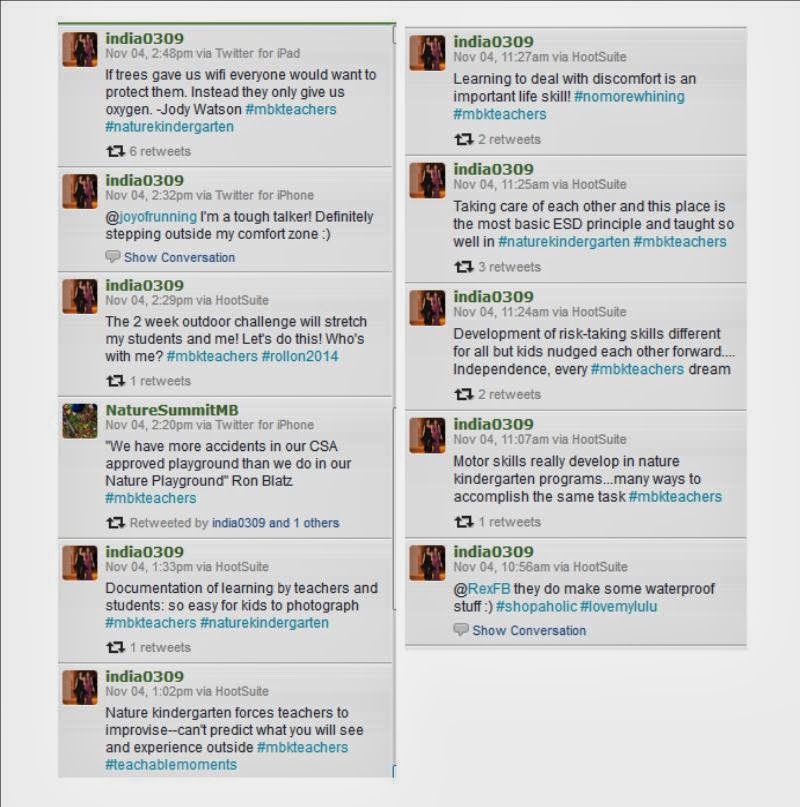
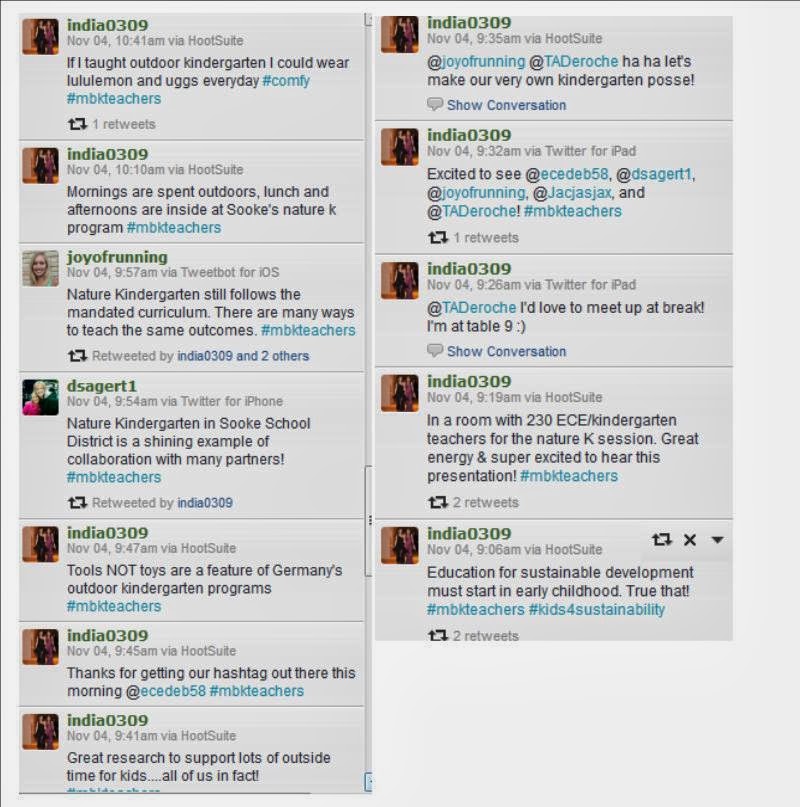
It was also a great day for connecting with some of my favourite kindergarten colleagues, and we had a lively back chat running with the hashtag #mbkteachers. Take a look at some of the tweets I sent as I reflected on and shared my learning throughout the day.

 So unfortunately most of us who teach kindergarten in Manitoba don't have access to an amazing forest and beach area like our presenters do for their program. But it's all about scaling nature kindergarten to your own classroom practice! And after some inspiring conversation with colleagues during the day and a two hour ride home to plan, here's what I'm thinking so far:
Maximizing my Learning Gardens/Outdoor Classroom: I am very fortunate to have a door that opens onto our outdoor classroom and learning gardens. There's raised vegetable beds, fruit trees, a pergola with great big rocks for sitting, and a beautiful mural on the school walls. How have I used it so far? Well I've read stories out there, we've had picnic lunches, provided chalk for writing and drawing on the sidewalk, set up my water table there, and taken various other toys outside for play. How can I make better use of this terrific space that is so conveniently located beside my classroom?
-install a chalkboard to make writing materials more readily available to students
-get students more actively involved in gardening (one colleague suggested herb gardens in old tires)
-turn the outdoor classroom into an actual extension of our indoor classroom where students always have the option to read, work, play, etc.
Outdoor Kits/Packs:the presenters talked about how every student has a backpack of supplies that accompanies him/her each day on outdoor excursions. What would I include in an outdoor kit for my students?
-magnifying glass
-clipboard with paper and pencils/markers for documenting learning, making notes, etc.
-iPad or Microsoft Surface in a waterproof/shockproof case would be perfect to capture photographs, create drawings and images. Also mobile devices with the SMART Notebook app would be terrific to enable students to participate in a variety of learning experiences.
-a change of clothes, extra mittens, etc.
-water bottle and snack
-my teacher pack would include tissues, hand sanitizer, baby wipes, cell phone, digital camera, band aids, and other supplies depending on the day.
Tools Instead of Toys: the presenters raised an excellent point that our kids don't need more toys to enhance play and learning. Instead they need age-appropriate tools that they can use for a variety of tasks. The richest learning usually occurs when students are planning and completing activities that have a very real word purpose, and it only makes sense that we require real tools for authentic learning.
Venturing Further Afield: within ten minutes, I have access to a pumpkin patch, marshes, and a lake with a beach. If I can organize transportation and obtain board approval to visit these sites, a whole world of learning opportunities open up. There is also lots of green space in our community within walking distance of the school. We just need to get out there and explore!
Take the Two Weeks Outdoors Challenge: I've thrown caution to the wind and signed up for this. Keeping my fingers crossed for great weather this spring :) Are you brave enough to take the challenge? Let me know if you are as it would be great to plan some activities together!
Our First Outdoor Learning Activity: since we were already learning about dinosaurs (see previous blog post here), I planned a learning experience to explore how big the dinosaurs were. Since our classroom wasn't big enough to physically measure out the dinosaurs, going outdoors seemed like a great option. We chose five dinosaurs and used Bing to find out how long they were (check out Bing for Schools--such a great program). Even though Canada uses the metric system, I made the decision to use feet. This would allow us to physically pace out the length of dinosaurs rather than use a metre stick or tape measure (just too difficult for 5 year olds). We looked at the metre stick and talked about how many of our feet made up a metre. Then we printed the numbers to represent how many feet long each dinosaur was.

We printed out the posters we made for each dinosaur (see above), and took them outside with our camera, pylons, and tape.
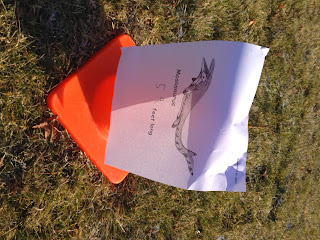 The kids were thrilled to be learning outside and they kept thinking that they were getting another recess even though they were involved in a structured learning activity. When one little girl looked at me and said, "Mrs. Caldwell, I don't think I've even seen you outside before", it really made me realize that we needed to do more of this!
It was a great opportunity to develop numeracy skills while incorporating bodily-kinesthetic learning styles as we paced out each dinosaur--we all held hands in a line and counted each step out loud. We used pylons to show the head and the tail of each dinosaur and taped our signs to them. This allowed us to make comparisons about the lengths of the dinosaurs.
 This is how long an apatosaurus is!
 This picture shows how long the five dinosaurs are that we measured, from longest to shortest.
So our first outdoor learning experience was a huge success. The cool temperatures kept everyone alert, and physically measuring the size of the dinosaurs made the learning experience real to the students in a way that wasn't possible inside. The only way it could be improved upon was pointed out by one student--"Can we have hot chocolate next time?"
So give it a try--bring nature into your kindergarten program. It's nothing revolutionary, it's available to everyone in some shape or form, and you and your young learners might be surprised where it leads you.
Another great resource...
Playing with Sticks: Forest Kindergarten and Nature Play
It was also a great day for connecting with some of my favourite kindergarten colleagues, and we had a lively back chat running with the hashtag #mbkteachers. Take a look at some of the tweets I sent as I reflected on and shared my learning throughout the day.
Maximizing my Learning Gardens/Outdoor Classroom: I am very fortunate to have a door that opens onto our outdoor classroom and learning gardens. There's raised vegetable beds, fruit trees, a pergola with great big rocks for sitting, and a beautiful mural on the school walls. How have I used it so far? Well I've read stories out there, we've had picnic lunches, provided chalk for writing and drawing on the sidewalk, set up my water table there, and taken various other toys outside for play. How can I make better use of this terrific space that is so conveniently located beside my classroom?
-install a chalkboard to make writing materials more readily available to students
-get students more actively involved in gardening (one colleague suggested herb gardens in old tires)
-turn the outdoor classroom into an actual extension of our indoor classroom where students always have the option to read, work, play, etc.
Outdoor Kits/Packs:the presenters talked about how every student has a backpack of supplies that accompanies him/her each day on outdoor excursions. What would I include in an outdoor kit for my students?
-magnifying glass
-clipboard with paper and pencils/markers for documenting learning, making notes, etc.
-iPad or Microsoft Surface in a waterproof/shockproof case would be perfect to capture photographs, create drawings and images. Also mobile devices with the SMART Notebook app would be terrific to enable students to participate in a variety of learning experiences.
-a change of clothes, extra mittens, etc.
-water bottle and snack
-my teacher pack would include tissues, hand sanitizer, baby wipes, cell phone, digital camera, band aids, and other supplies depending on the day.
Tools Instead of Toys: the presenters raised an excellent point that our kids don't need more toys to enhance play and learning. Instead they need age-appropriate tools that they can use for a variety of tasks. The richest learning usually occurs when students are planning and completing activities that have a very real word purpose, and it only makes sense that we require real tools for authentic learning.
Venturing Further Afield: within ten minutes, I have access to a pumpkin patch, marshes, and a lake with a beach. If I can organize transportation and obtain board approval to visit these sites, a whole world of learning opportunities open up. There is also lots of green space in our community within walking distance of the school. We just need to get out there and explore!
Take the Two Weeks Outdoors Challenge: I've thrown caution to the wind and signed up for this. Keeping my fingers crossed for great weather this spring :) Are you brave enough to take the challenge? Let me know if you are as it would be great to plan some activities together!
Our First Outdoor Learning Activity: since we were already learning about dinosaurs (see previous blog post here), I planned a learning experience to explore how big the dinosaurs were. Since our classroom wasn't big enough to physically measure out the dinosaurs, going outdoors seemed like a great option. We chose five dinosaurs and used Bing to find out how long they were (check out Bing for Schools--such a great program). Even though Canada uses the metric system, I made the decision to use feet. This would allow us to physically pace out the length of dinosaurs rather than use a metre stick or tape measure (just too difficult for 5 year olds). We looked at the metre stick and talked about how many of our feet made up a metre. Then we printed the numbers to represent how many feet long each dinosaur was.

We printed out the posters we made for each dinosaur (see above), and took them outside with our camera, pylons, and tape.

It was a great opportunity to develop numeracy skills while incorporating bodily-kinesthetic learning styles as we paced out each dinosaur--we all held hands in a line and counted each step out loud. We used pylons to show the head and the tail of each dinosaur and taped our signs to them. This allowed us to make comparisons about the lengths of the dinosaurs.


So our first outdoor learning experience was a huge success. The cool temperatures kept everyone alert, and physically measuring the size of the dinosaurs made the learning experience real to the students in a way that wasn't possible inside. The only way it could be improved upon was pointed out by one student--"Can we have hot chocolate next time?"
So give it a try--bring nature into your kindergarten program. It's nothing revolutionary, it's available to everyone in some shape or form, and you and your young learners might be surprised where it leads you.
Another great resource...
Playing with Sticks: Forest Kindergarten and Nature Play
Tuesday, November 26, 2013
Smarter with Technology: Brandon University, November 22
I had the privilege of presenting to Brandon University's Faculty of Education students last Friday. As always it was a great day, sharing and learning from each other on how to infuse SMART Board technology and SMART Notebook software in the early years classroom!
For student feedback and participation:
Poll Everywhere
Today's Meet (back channel)
Extreme Collaboration (SMART Notebook add on)
In my kindergarten classroom:
Calendar Activities
Early Years SMART Board Activities
More SMART Board Tips and Tricks
SMART Notebook App
Other resources:
Turning a Skype Call into a Learning Call
Silvia Rosenthal Tolisano, Around the World With Skype
Learning Activity Checklist
Developed for the Microsoft Peer Coaching Program, now Peer-Ed
Favourite Resources
For student feedback and participation:
Poll Everywhere
Today's Meet (back channel)
Extreme Collaboration (SMART Notebook add on)
In my kindergarten classroom:
Calendar Activities
Early Years SMART Board Activities
More SMART Board Tips and Tricks
SMART Notebook App
Other resources:
Turning a Skype Call into a Learning Call
Silvia Rosenthal Tolisano, Around the World With Skype
Learning Activity Checklist
Developed for the Microsoft Peer Coaching Program, now Peer-Ed
Favourite Resources
Subscribe to:
Posts (Atom)